As AI systems become more autonomous, developers increasingly need infrastructure for building:
- AI agents
- reasoning systems
- tool-using workflows
- memory architectures
- multi-agent systems
- orchestration pipelines
This has led to the rapid rise of:
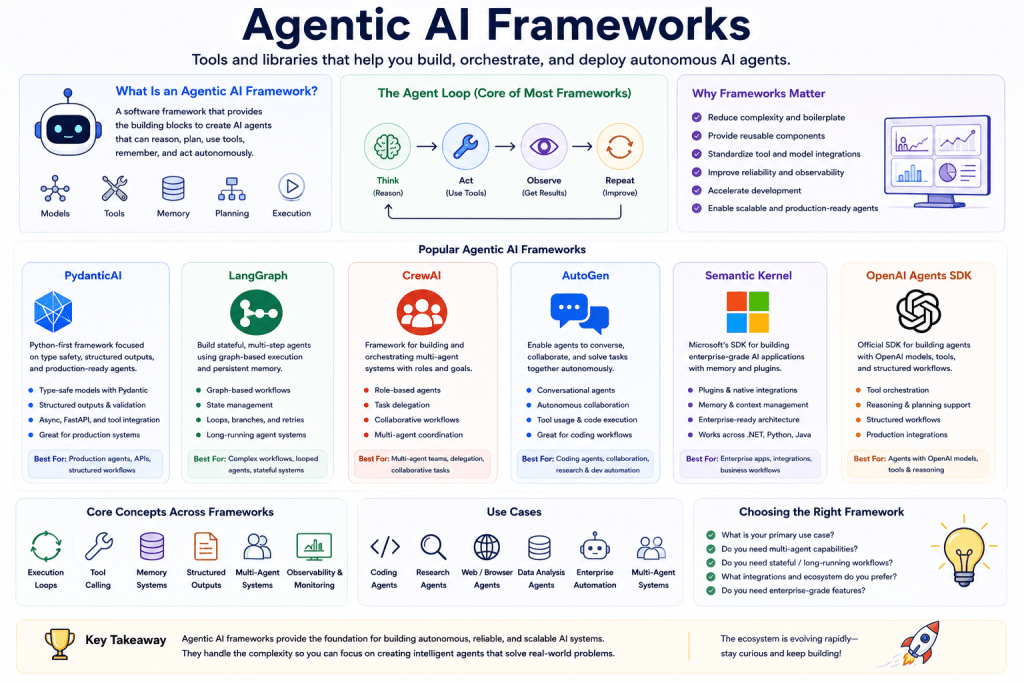
Agentic AI Frameworks
These frameworks provide the building blocks needed to create AI systems capable of:
- planning
- tool usage
- memory management
- execution loops
- reflection
- workflow orchestration
- autonomous behavior
Instead of manually wiring every component together, developers can use frameworks that handle much of the underlying infrastructure.
This pillar page introduces the major frameworks, architectural concepts, and ecosystem trends shaping modern Agentic AI development.
What Is an Agentic AI Framework?
An Agentic AI framework is a software platform that helps developers build autonomous AI systems.
These frameworks typically provide:
- model orchestration
- tool integration
- memory systems
- execution loops
- planning systems
- agent coordination
- observability
- workflow management
In simple terms:
Frameworks help transform language models into operational software agents.
Why Frameworks Matter
Building AI agents from scratch quickly becomes complicated.
Even a relatively simple agent may require:
- LLM integration
- tool calling
- memory handling
- retry logic
- planning systems
- execution orchestration
- logging
- context management
Frameworks reduce this complexity by providing reusable abstractions.
This allows developers to focus more on:
- workflows
- agent behavior
- domain logic
and less on: - plumbing
- orchestration infrastructure
The Rise of Agent Engineering
The emergence of AI frameworks has helped create a new discipline:
Agent Engineering
Agent engineering combines:
- software engineering
- AI orchestration
- workflow design
- reasoning systems
- memory architectures
- tool ecosystems
- execution control
Modern frameworks are rapidly becoming the foundation of this ecosystem.
Major Agentic AI Frameworks
Several frameworks now dominate the Agentic AI landscape.
PydanticAI
One of the fastest-growing frameworks for Python-first agent development.
Pydantic AI focuses heavily on:
- structured outputs
- type safety
- model validation
- clean Python integration
- production-oriented development
It integrates naturally with:
- Pydantic models
- async Python
- FastAPI
- tool calling systems
Common Use Cases
- production AI agents
- structured workflows
- enterprise orchestration
- API-connected agents
- tool-driven automation
Recommended Articles
- What Is Pydantic AI?
- Building Your First Pydantic AI Agent
- Structured Outputs with Pydantic AI
- Pydantic AI vs LangGraph
LangGraph
LangGraph focuses heavily on:
- graph-based execution
- stateful workflows
- execution loops
- memory persistence
- multi-step orchestration
Instead of linear pipelines, LangGraph models workflows as:
- nodes
- edges
- state transitions
This is especially useful for:
- long-running agents
- complex workflows
- reasoning loops
- multi-agent systems
Key Concepts
- graph execution
- state management
- cyclical workflows
- branching logic
- persistent execution
Recommended Articles
- What Is LangGraph?
- Building Stateful AI Agents
- Graph-Based Agent Loops Explained
- LangGraph Memory Systems
CrewAI
CrewAI specializes in:
Multi-Agent Systems
Instead of a single agent handling all tasks, CrewAI enables:
- specialized agents
- delegation
- collaborative workflows
- role-based orchestration
Example:
Research Agent ↓Planning Agent ↓Coding Agent ↓Evaluation Agent
This architecture is becoming increasingly important for:
- enterprise automation
- research systems
- autonomous coordination
Recommended Articles
- What Is CrewAI?
- Multi-Agent Systems Explained
- Delegation Patterns in AI Agents
AutoGen
AutoGen focuses heavily on:
- conversational multi-agent collaboration
- autonomous interactions
- tool orchestration
- coding workflows
Agents communicate with each other dynamically to solve tasks collaboratively.
AutoGen became particularly popular for:
- coding agents
- collaborative systems
- autonomous debugging workflows
Common Patterns
- agent conversations
- role-based reasoning
- collaborative planning
- execution-feedback loops
Semantic Kernel
Semantic Kernel focuses on:
- enterprise orchestration
- AI workflows
- memory systems
- plugin architectures
- integration with Microsoft ecosystems
It combines:
- traditional software engineering
with: - AI orchestration patterns
This makes it attractive for enterprise adoption.
OpenAI Agents SDK
The OpenAI Agents SDK focuses on:
- tool orchestration
- agent execution
- structured workflows
- reasoning systems
- production integrations
The SDK is increasingly aligned with:
- reasoning models
- MCP ecosystems
- tool-based architectures
- execution orchestration
Core Architectural Concepts
Despite their differences, most agent frameworks share common ideas.
1. Execution Loops
Most frameworks revolve around recurring agent loops:
Think → Act → Observe → Repeat
This loop enables:
- planning
- adaptation
- retries
- reflection
- autonomous execution
2. Tool Calling
Modern agents increasingly rely on tools.
Common integrations include:
- APIs
- databases
- browsers
- Python interpreters
- search systems
- file systems
- MCP servers
Frameworks standardize these interactions.
3. Memory Systems
Most advanced frameworks support memory architectures.
Examples:
- short-term memory
- long-term memory
- vector retrieval
- semantic memory
- execution history
Memory is critical for:
- continuity
- personalization
- long-running workflows
4. Structured Outputs
Many frameworks emphasize structured outputs using:
- schemas
- typed objects
- validation systems
This improves:
- reliability
- predictability
- downstream integration
5. Multi-Agent Coordination
Modern frameworks increasingly support:
- delegation
- collaboration
- role specialization
- distributed reasoning
Multi-agent systems are becoming one of the most important areas in Agentic AI.
Frameworks vs Raw API Development
Developers can build agents directly using APIs —
but frameworks provide important advantages.
Raw API Approach
Custom orchestrationCustom memoryCustom retriesCustom tool managementCustom state handling
Flexible —
but increasingly difficult to maintain.
Framework Approach
Reusable abstractionsBuilt-in orchestrationIntegrated memoryStructured workflowsExecution management
Graph-Based Architectures
Many modern frameworks are shifting toward:
Graph-Based Execution
Instead of linear workflows:
A → B → C
Graph systems allow:
- branching
- loops
- retries
- parallel execution
- dynamic routing
This is increasingly important for complex autonomous systems.
MCP and Framework Ecosystems
Modern frameworks increasingly integrate with:
MCP
(Model Context Protocol)
MCP helps standardize:
- tool communication
- context sharing
- capability discovery
- interoperability
This may become foundational infrastructure for future agent ecosystems.
AI Frameworks and Reasoning Models
Frameworks increasingly optimize for:
- reasoning models
- chain-of-thought workflows
- planning systems
- reflection loops
The focus is shifting from:
- simple prompt chains
to: - reasoning-driven execution systems
This is one of the defining trends in modern Agentic AI.
Common Framework Use Cases
Modern frameworks are used for:
Coding Agents
Generate, debug, and execute code.
Research Agents
Search, summarize, and synthesize information.
RAG Systems
Combine retrieval with reasoning.
Enterprise Automation
Automate workflows across systems.
Browser Agents
Interact with websites autonomously.
Data Analysis Agents
Process datasets and generate insights.
Multi-Agent Coordination
Specialized agents collaborate together.
Challenges in Agent Frameworks
Despite rapid progress, frameworks still face major challenges.
Reliability
Agents may:
- hallucinate
- misuse tools
- fail workflows
- lose context
Complexity
Large orchestration systems become difficult to manage.
Cost
Long-running reasoning systems consume:
- tokens
- compute
- API calls
Observability
Monitoring autonomous agents remains difficult.
Frameworks increasingly add:
- tracing
- logging
- evaluation systems
- debugging tools
Security
Tool-enabled agents create:
- permission risks
- data exposure risks
- execution vulnerabilities
Security is becoming one of the most important framework concerns.
The Future of Agentic AI Frameworks
The framework ecosystem is evolving rapidly.
Major trends include:
- reasoning-first architectures
- graph execution systems
- multi-agent orchestration
- MCP integration
- persistent memory
- enterprise governance
- autonomous workflow systems
Future frameworks may resemble:
- operating systems for AI agents
rather than simple orchestration libraries.
Suggested Learning Path
If you are new to Agentic AI frameworks, a practical path is:
Beginner
- What Is Agentic AI?
- AI Agents vs AI Workflows
- The Basic Agent Loop
- What Is MCP?
Intermediate
- Build a Simple Python Agent
- Tool Calling Explained
- What Are AI Agent Skills?
- Pydantic AI vs LangGraph
Advanced
- Multi-Agent Systems
- Reflection Loops
- Production AI Agents
- MCP Server Architectures
- Agent Evaluation Systems
Related Topics
Frameworks connect closely to:
- reasoning systems
- chain-of-thought reasoning
- AI agent skills
- MCP servers
- execution orchestration
- memory systems
- RAG pipelines
- multi-agent systems
- autonomous workflows
Together, these concepts form the infrastructure foundation of modern Agentic AI.
Final Thoughts
Agentic AI frameworks are rapidly becoming the infrastructure layer behind modern autonomous AI systems.
They provide the orchestration needed for:
- reasoning
- memory
- tool usage
- planning
- execution loops
- multi-agent coordination
As AI systems become more autonomous and capable, frameworks will likely play the same role for AI agents that:
- web frameworks played for websites
or - cloud platforms played for distributed applications.
Understanding these frameworks is becoming essential for developers building the next generation of intelligent software systems.
 Programming Agentic AI