Modern AI agents are far more than chatbots.
The most advanced agentic AI systems can:
- reason through problems
- plan tasks
- use tools
- remember information
- interact with software
- recover from errors
- coordinate workflows
- collaborate with other agents
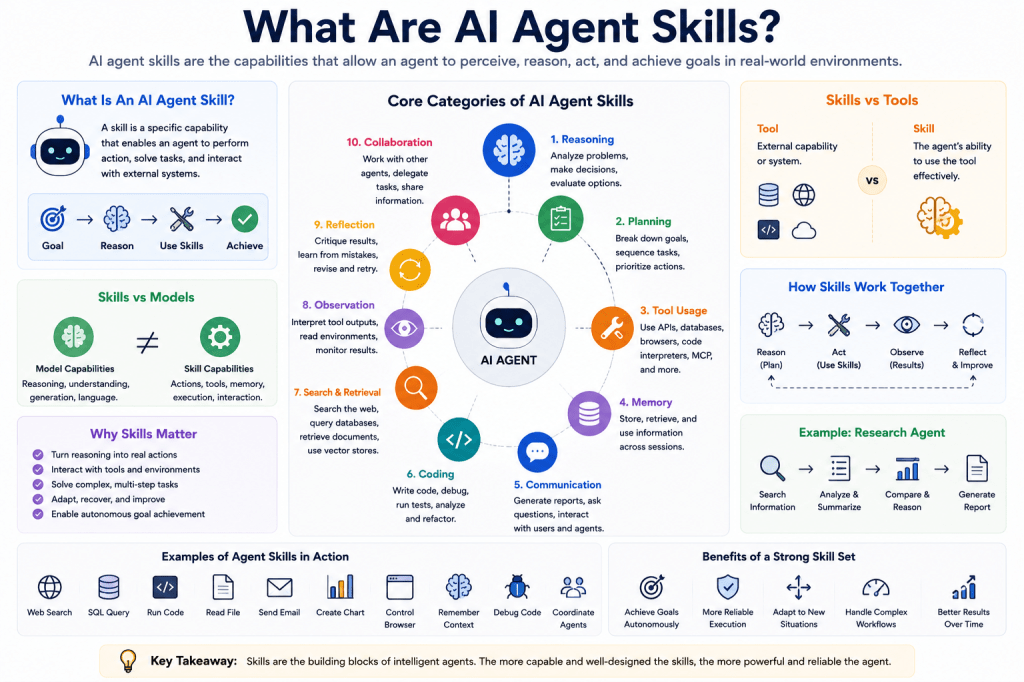
These capabilities are often referred to as:
AI Agent Skills
Agent skills are the functional abilities that allow AI systems to operate autonomously and pursue goals across complex environments.
In simple terms:
Skills determine what an AI agent can actually do.
Understanding agent skills is one of the most important concepts in Agentic AI engineering because modern agents are increasingly being designed as collections of reusable capabilities.
Defining AI Agent Skills
An AI agent skill is a specialized capability that enables an agent to:
- perform actions
- solve tasks
- interact with environments
- make decisions
- execute workflows
Examples include:
- web searching
- coding
- planning
- memory retrieval
- summarization
- browser control
- data analysis
- API interaction
A single AI agent may contain dozens or even hundreds of individual skills.
Skills vs Models
One important distinction:
The model is not the skill.
The large language model provides:
- reasoning
- language understanding
- generation
Skills provide:
- actions
- execution
- environment interaction
- specialized capabilities
Example:
Model Capability
Explain how SQL works.
Skill Capability
Connect to databaseRun SQL queryReturn resultsGenerate chart
Skills transform AI systems from conversational models into operational systems.
Why AI Agent Skills Matter
Without skills, AI agents are mostly limited to:
- answering questions
- generating text
- explaining concepts
Skills enable agents to:
- interact with software
- manipulate environments
- automate workflows
- execute multi-step tasks
- achieve goals autonomously
This is one of the key differences between:
- chatbots
and - true agentic systems
Core Categories of AI Agent Skills
Most modern agent skills fall into several major categories.
1. Reasoning Skills
Reasoning skills allow agents to:
- analyze problems
- decompose tasks
- evaluate options
- make decisions
- revise plans
These skills often rely on:
- chain-of-thought reasoning
- reflection loops
- planning systems
- iterative evaluation
Example:
Goal:Build market research report.Reasoning:1. Identify competitors2. Gather pricing data3. Compare features4. Summarize findings
Reasoning is one of the foundational skills behind Agentic AI.
2. Planning Skills
Planning skills help agents organize actions over time.
Examples include:
- task decomposition
- prioritization
- sequencing
- dependency tracking
- workflow orchestration
Example:
Task:Deploy application.Plan:1. Run tests2. Build container3. Push image4. Deploy service5. Verify health checks
Planning transforms isolated actions into coordinated execution.
3. Tool Usage Skills
Tool usage skills allow agents to interact with external systems.
Common tools include:
- APIs
- databases
- browsers
- Python interpreters
- file systems
- MCP servers
- cloud services
Examples:
- sending emails
- querying SQL
- scraping websites
- generating charts
- editing documents
- calling APIs
Tool usage is one of the most important components of modern AI agents.
4. Memory Skills
Memory skills allow agents to:
- store information
- retrieve past context
- maintain continuity
- learn from prior actions
Memory systems may include:
Short-Term Memory
Current task context.
Long-Term Memory
Persistent storage across sessions.
Semantic Memory
Embedding-based retrieval.
Episodic Memory
Tracking prior actions and outcomes.
Without memory, agents become:
- repetitive
- forgetful
- fragile
5. Communication Skills
Communication skills allow agents to:
- generate reports
- ask questions
- summarize information
- interact with users
- coordinate with other agents
Examples:
- email generation
- conversational interfaces
- notifications
- multi-agent coordination
Communication is essential in collaborative systems.
6. Coding Skills
Modern coding agents can:
- generate code
- debug software
- run tests
- analyze repositories
- execute scripts
- revise implementations
Example:
1. Detect bug2. Inspect traceback3. Modify code4. Run tests5. Verify fix
Coding skills are becoming increasingly important in software engineering automation.
7. Search and Retrieval Skills
Search skills allow agents to:
- browse the web
- query databases
- retrieve documents
- access vector stores
- search internal knowledge systems
Examples:
- RAG systems
- semantic search
- enterprise search
- documentation retrieval
These skills are critical for grounding agents in external knowledge.
8. Observation Skills
Observation skills allow agents to interpret:
- API responses
- tool outputs
- execution logs
- webpage content
- environmental changes
Observation is central to the agent loop:
Think → Act → Observe → Repeat
Without observation, agents cannot adapt.
9. Reflection Skills
Reflection skills enable self-evaluation.
The agent can:
- critique outputs
- identify errors
- revise plans
- retry failed actions
Example:
Generate Code ↓Run Tests ↓Analyze Failures ↓Rewrite Logic ↓Retry
Reflection significantly improves reliability.
10. Multi-Agent Collaboration Skills
Advanced systems may involve multiple agents working together.
Examples:
- planning agents
- coding agents
- evaluation agents
- research agents
Collaboration skills include:
- delegation
- negotiation
- coordination
- task handoff
- shared memory
Multi-agent systems are becoming increasingly important in enterprise AI architectures.
Skills vs Tools
Skills and tools are related —
but they are not identical.
Tool
A tool is an external capability.
Examples:
- SQL database
- browser
- API
- Python interpreter
Skill
A skill is the agent’s ability to use the tool effectively.
Example:
Tool:SQL databaseSkill:Write correct queries,analyze results,detect anomalies,summarize findings
The distinction is extremely important.
Skills Can Be Modular
Modern agent architectures increasingly use modular skill systems.
Example:
Agent ├── Search Skill ├── Planning Skill ├── Memory Skill ├── Coding Skill └── Reflection Skill
This modularity allows:
- reuse
- specialization
- composability
- scalability
Skill Composition
Advanced agents often combine multiple skills together.
Example:
Research Agent
Search Skill ↓Summarization Skill ↓Reasoning Skill ↓Report Generation Skill
This chaining creates sophisticated workflows.
AI Agent Skill Trees
Some systems organize skills hierarchically.
Example:
Coding Skill ├── Debugging ├── Refactoring ├── Testing └── Documentation
This resembles:
- game skill trees
- modular software systems
- capability graphs
Skill hierarchies may become increasingly important as agents grow more capable.
Skill Learning
Future systems may dynamically learn new skills.
Possible mechanisms include:
- fine-tuning
- reinforcement learning
- tool discovery
- demonstration learning
- memory accumulation
This is an active area of research.
Agent Skills in Modern Frameworks
Modern frameworks increasingly revolve around reusable skills and tools.
Examples include:
- PydanticAI
- LangGraph
- CrewAI
- AutoGen
- Semantic Kernel
- OpenAI Agents SDK
These frameworks support:
- tool integration
- skill orchestration
- memory systems
- execution loops
- multi-agent collaboration
Challenges with Agent Skills
Despite rapid progress, agent skills still face important challenges.
Reliability
Skills may fail unexpectedly.
Examples:
- invalid API calls
- hallucinated tool usage
- incorrect reasoning
Security
Tool-enabled agents can become dangerous if improperly controlled.
Examples:
- file deletion
- unauthorized API access
- sensitive data exposure
Skill Coordination
Complex systems may struggle with:
- conflicting goals
- dependency management
- state synchronization
Evaluation
Measuring skill quality remains difficult.
Questions include:
- Did the agent complete the task correctly?
- Was the plan efficient?
- Were tools used properly?
- Was the reasoning valid?
The Future of AI Agent Skills
Agent skills are likely to become increasingly:
- modular
- reusable
- composable
- specialized
Future systems may behave more like operating systems for AI capabilities.
Possible future directions include:
- skill marketplaces
- dynamically loaded skills
- autonomous skill discovery
- transferable skills
- collaborative skill ecosystems
This could fundamentally change how software systems are designed.
Related Concepts
AI agent skills connect closely to:
- tool calling
- planning systems
- chain-of-thought reasoning
- memory architectures
- reflection loops
- execution orchestration
- multi-agent systems
- MCP servers
- autonomous workflows
Together, these concepts form the foundation of modern Agentic AI.
Final Thoughts
AI agent skills are the functional capabilities that transform language models into autonomous software systems.
They allow agents to:
- reason
- plan
- act
- observe
- remember
- communicate
- collaborate
- execute complex tasks
As Agentic AI continues evolving, skills will become one of the central building blocks of intelligent software architectures.
Understanding agent skills is essential for anyone building:
- AI agents
- autonomous workflows
- coding assistants
- research systems
- production-grade agentic applications
The future of Agentic AI will likely depend not only on larger models —
but on richer, more reliable, and more composable agent skills.
 Programming Agentic AI