One of the most important capabilities in modern Agentic AI systems is:
Tool Calling
Tool calling allows AI models to move beyond simple text generation and begin interacting with:
- APIs
- databases
- web services
- Python functions
- file systems
- browsers
- external software systems
Without tool calling, AI systems are mostly limited to:
- answering questions
- generating text
- summarizing information
With tool calling, AI systems can:
- execute workflows
- retrieve live data
- automate tasks
- interact with environments
- orchestrate software systems
Tool calling is one of the foundational technologies behind:
- AI agents
- coding assistants
- autonomous workflows
- research systems
- enterprise AI platforms
This article explains tool calling from a Python developer’s perspective and shows how it works in modern AI systems.
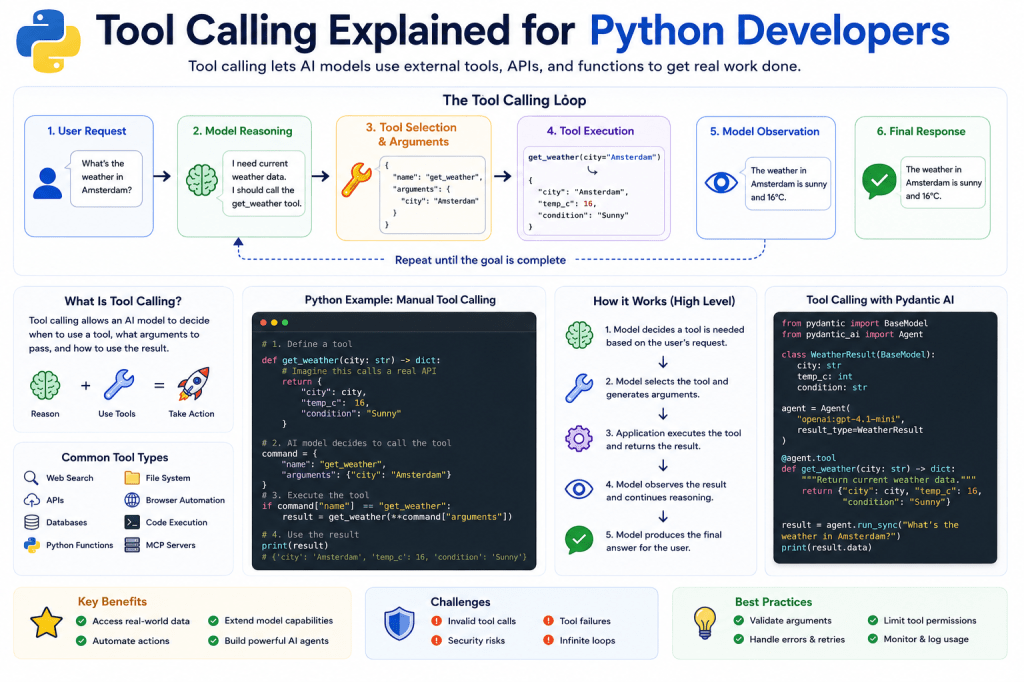
What Is Tool Calling?
Tool calling is the process where an AI model:
- decides a tool is needed
- selects the correct tool
- generates arguments
- executes the tool
- observes the result
- continues reasoning
A simplified flow looks like:
User Request ↓LLM Reasoning ↓Tool Selection ↓Tool Execution ↓Observation ↓Final Response
This architecture is central to modern Agentic AI.
Why Tool Calling Matters
Language models alone are limited.
A model without tools:
- cannot access real-time data
- cannot query databases
- cannot execute code
- cannot interact with external systems
Tool calling transforms AI from:
- static text generators
into: - operational software agents
This is one of the biggest shifts in modern AI engineering.
Examples of AI Tools
Modern AI agents commonly use tools such as:
- web search
- SQL queries
- Python execution
- weather APIs
- file systems
- browser automation
- vector databases
- MCP servers
- GitHub APIs
- cloud services
Tool ecosystems are expanding rapidly.
A Simple Mental Model
You can think of tool calling as:
“Function calling for AI systems.”
Instead of only generating text, the model can dynamically invoke capabilities.
Example:
User:"What is the weather in Amsterdam?"
The model may decide:
Call weather API
Then:
- retrieve the result
- analyze the output
- generate a final response
Traditional Software vs AI Tool Calling
Traditional software usually works like:
Input ↓Fixed Logic ↓Output
AI systems behave differently:
Input ↓Reasoning ↓Dynamic Tool Selection ↓Execution ↓Observation ↓Response
The AI dynamically decides which actions are needed.
Basic Python Tool Calling Example
Let’s start with a very simple Python function.
Example:
def get_weather(city: str): return f"The weather in {city} is sunny."
Normally, Python developers call this directly:
result = get_weather("Amsterdam")
Tool calling allows the AI model itself to decide:
- when to call the function
- what arguments to use
This is the key difference.
Tool Calling Architecture
Modern AI systems often follow this pattern:
User Prompt ↓LLM Determines Tool ↓Tool Executes ↓Result Returned ↓LLM Generates Final Response
This creates dynamic execution behavior.
Why Tool Calling Is Central to AI Agents
Modern AI agents operate inside loops:
Think → Act → Observe → Repeat
Tool calling powers the:
ACT
phase.
Without tools:
- agents cannot interact with the world
With tools:
- agents become operational systems
Manual Tool Calling Example in Python
Here is a simple conceptual example.
Step 1 — Create a Tool
def search_database(query: str): database = { "vector databases": "Used for semantic search." } return database.get( query.lower(), "No results found." )
Step 2 — Simulate AI Reasoning
result = search_database(tool_argument)print(result)
Step 3 — Execute the Tool
result = search_database(tool_argument)print(result)
Output:
Used for semantic search.
This demonstrates the core idea.
Modern Tool Calling Frameworks
Modern frameworks automate much of this process.
Examples include:
- PydanticAI
- LangGraph
- CrewAI
- AutoGen
- OpenAI Agents SDK
These frameworks handle:
- tool registration
- argument parsing
- execution orchestration
- validation
- retries
- state management
Tool Calling in Pydantic AI
PydanticAI provides elegant tool registration.
Example:
agent.tooldef search(query: str) -> str: return "Search results..."
The framework automatically:
- exposes the tool
- validates arguments
- orchestrates execution
This dramatically simplifies agent development.
Structured Tool Inputs
Modern systems often define structured schemas for tools.
Example:
class WeatherRequest(BaseModel): city: str
Structured schemas improve:
- reliability
- validation
- predictability
This is becoming increasingly important in production AI systems.
Tool Calling and MCP
Modern agent ecosystems increasingly use:
MCP
(Model Context Protocol)
MCP standardizes:
- tool discovery
- capability exposure
- context sharing
- interoperability
Instead of manually wiring every tool, MCP allows agents to interact with standardized tool servers.
This is becoming increasingly important in large agent ecosystems.
Common Categories of AI Tools
1. Search Tools
Examples:
- web search
- documentation search
- semantic retrieval
- vector databases
Used heavily in:
- research agents
- RAG systems
2. Execution Tools
Examples:
- Python interpreters
- shell commands
- SQL execution
Common in:
- coding agents
- automation systems
3. Communication Tools
Examples:
- email APIs
- messaging systems
- notifications
Common in:
- enterprise assistants
4. Browser Tools
Examples:
- webpage navigation
- scraping
- form automation
Common in:
- browser agents
5. File Tools
Examples:
- reading documents
- saving reports
- managing directories
Used in:
- productivity agents
- coding systems
Tool Calling and Reasoning
Reasoning models increasingly decide:
- which tools to use
- when to use them
- how to sequence actions
- how to recover from failures
Example:
Goal:Research AI frameworksReasoning:1. Search documentation2. Compare features3. Summarize differences
This combination of:
- reasoning
plus - tool execution
is one of the foundations of Agentic AI.
Multi-Step Tool Workflows
Advanced agents chain multiple tools together.
Example:
Web Search ↓Retrieve Documents ↓Analyze Data ↓Generate Report
This creates autonomous workflows.
Reflection and Tool Use
Advanced systems often critique tool outputs.
Example:
Call Tool ↓Observe Result ↓Validate Output ↓Retry if Needed
Reflection improves reliability significantly.
Async Tool Calling
Modern production agents often use:
Async Python
because tools may:
- wait on APIs
- process files
- query databases
- perform network requests
Example:
async def search(): ...
Async architectures improve scalability.
Common Problems with Tool Calling
Despite its power, tool calling introduces challenges.
Hallucinated Tool Calls
Models may:
- invent tools
- generate invalid arguments
- misuse APIs
Validation systems are essential.
Security Risks
Tool-enabled agents can:
- delete files
- expose sensitive data
- misuse APIs
Permission systems are critical.Security Risks
Tool Failures
External systems may:
- timeout
- crash
- change schemas
Agents must handle these failures gracefully.
Infinite Loops
Agents may repeatedly retry failing tools.
Example:
Tool fails ↓Retry ↓Tool fails again
Systems need:
- retry limits
- monitoring
- safeguards
Why Tool Calling Changes Everything
Tool calling fundamentally changes AI systems because it allows models to:
- interact with environments
- manipulate software systems
- retrieve live information
- automate workflows
- execute actions
This transforms AI from:
- passive generation
into: - active execution
That is the core shift behind Agentic AI.
Suggested Next Steps
After learning basic tool calling, useful next projects include:
- building a research agent
- creating a coding assistant
- integrating vector databases
- adding browser automation
- building MCP-based systems
- implementing reflection loops
- orchestrating multi-agent workflows
Related Topics
Tool calling connects closely to:
- AI agents
- reasoning systems
- execution loops
- MCP
- Python agent programming
- Pydantic AI
- memory systems
- autonomous workflows
- multi-agent systems
Together, these concepts form the operational infrastructure of modern Agentic AI systems.
Final Thoughts
Tool calling is one of the foundational technologies behind modern AI agents.
It allows AI systems to move beyond:
- static text generation
toward:
- execution
- automation
- orchestration
- environment interaction
For Python developers, understanding tool calling is becoming increasingly important because nearly every advanced Agentic AI system relies on some form of:
- tool orchestration
- execution management
- structured interaction with external systems
As AI systems continue evolving, tool calling will remain one of the key mechanisms that transforms language models into autonomous software agents.
 Programming Agentic AI