Artificial intelligence is entering a new phase.
For years, most AI systems focused on generating responses: answering questions, summarizing documents, translating text, or producing images. But modern AI systems are increasingly expected to do more than generate content. They are now being designed to reason, plan, use tools, remember information, and complete tasks autonomously.
This new paradigm is called Agentic AI.
Agentic AI combines large language models, reasoning systems, memory architectures, and software orchestration into systems capable of pursuing goals over multiple steps. Instead of acting like static chatbots, these systems behave more like software agents capable of interacting with the world around them.
This pillar page introduces the core concepts behind Agentic AI and links to the major foundational topics developers need to understand.
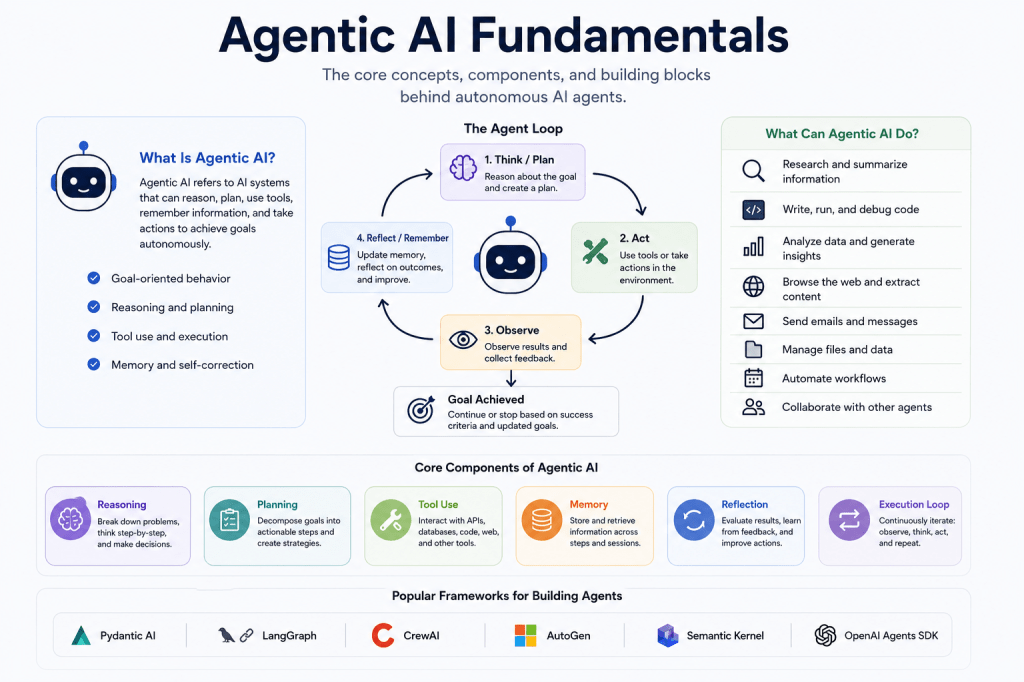
What Is Agentic AI?
Agentic AI refers to AI systems capable of:
- autonomous decision-making
- planning and execution
- tool usage
- memory management
- iterative reasoning
- multi-step workflows
- self-correction
Unlike traditional AI systems that generate single responses, agentic systems operate inside recurring loops of reasoning and action.
A simple mental model is:
Goal → Plan → Act → Observe → Reflect → Continue
The system continuously evaluates progress toward a goal.
Start Here
If you are new to the field, begin with these foundational articles:
Recommended Starting Articles
→ What Is Agentic AI?
The core introduction to autonomous AI systems, planning, reasoning loops, memory, and tool use.
→ AI Agents vs AI Workflows
Understand the difference between fixed automation pipelines and dynamic AI-driven systems.
→ The Basic Agent Loop: Think, Act, Observe, Repeat
A breakdown of how modern AI agents execute tasks iteratively.
→ What Is Chain-of-Thought Reasoning?
Learn how reasoning models break problems into intermediate steps before producing answers.
→ Why Reasoning Models “Think Longer”
An explanation of inference-time reasoning and multi-step computation.
→ Representation Learning Explained
Understand how neural networks learn internal representations of data and concepts.
→ What Are World Models?
Explore how AI systems internally model environments, outcomes, and future actions.
The Core Components of Agentic AI
Modern agentic systems are built from several interconnected components.
1. Reasoning
Reasoning allows AI systems to work through problems step-by-step instead of generating immediate responses.
Modern reasoning systems often use:
- chain-of-thought prompting
- reflection loops
- planning trees
- iterative evaluation
- self-consistency sampling
These techniques help agents:
- solve complex tasks
- debug errors
- revise plans
- improve reliability
Related Articles
- What Is Chain-of-Thought Reasoning?
- Why Reasoning Models “Think Longer”
- Self-Consistency Sampling Explained
- Representation Learning Explained
2. Planning
Planning enables agents to decompose goals into executable steps.
Example:
Goal: Build a market research report1. Search competitors2. Gather pricing data3. Analyze findings4. Generate charts5. Write summary6. Export report
Without planning, an agent becomes reactive rather than goal-driven.
Planning systems are often implemented using:
- task decomposition
- recursive reasoning
- graph execution
- planning trees
- workflow orchestration
3. Tool Usage
Agentic AI systems become dramatically more powerful when connected to external tools.
Common tools include:
- web search
- Python execution
- SQL databases
- APIs
- browsers
- vector databases
- file systems
- MCP servers
- cloud services
Tool use transforms AI systems from conversational assistants into operational software systems.
Related Articles
- Tool Calling Explained for Python Developers
- Build a Research Agent with Python
- How to Build a RAG Pipeline
- What Is MCP?
- What Are AI Agent Skills?
4. Memory
Memory enables agents to persist information across steps and sessions.
Without memory:
- agents forget context
- workflows break down
- continuity disappears
Modern agent systems often combine:
Short-Term Memory
Active task context.
Long-Term Memory
Persistent storage across sessions.
Semantic Memory
Embedding-based retrieval systems.
Episodic Memory
Records of prior actions and outcomes.
Related Articles
- What Is Agent Memory?
- RAG vs Larger Context Windows
- Embeddings Explained
- Vector Databases for AI Agents
5. Reflection and Self-Correction
Advanced agents can evaluate their own outputs and improve iteratively.
Example loop:
Generate → Test → Critique → Revise → Retry
Reflection significantly improves:
- code quality
- factual accuracy
- planning quality
- reliability
Reflection loops are becoming central to coding agents and autonomous software systems.
6. Execution Loops
One of the defining characteristics of agentic systems is continuous execution.
A traditional chatbot responds once.
An agent:
- continues operating
- tracks state
- monitors outcomes
- updates plans dynamically
This architecture often looks like:
Observe Environment ↓Reason About Goal ↓Select Action ↓Use Tool ↓Evaluate Result ↓Update Memory ↓Repeat
This recurring loop is the foundation of modern AI agents.
Agentic AI vs Traditional Automation
Traditional automation systems follow predefined rules.
Example:
IF condition → execute action
Agentic systems dynamically determine:
- which actions to take
- which tools to use
- how to adapt
- how to recover from failures
This creates systems that are:
- flexible
- adaptive
- context-aware
- goal-driven
Popular Agentic AI Frameworks
Several frameworks now dominate the agent engineering ecosystem.
Major Frameworks
- PydanticAI
- LangGraph
- CrewAI
- AutoGen
- Semantic Kernel
- OpenAI Agents SDK
These frameworks provide:
- orchestration
- memory systems
- tool integration
- multi-agent coordination
- observability
- execution control
Major Areas Within Agentic AI
The field is expanding rapidly into specialized domains.
Python AI Agents
Practical agent development using Python.
Topics include:
- tool calling
- async workflows
- memory systems
- CLI agents
- browser agents
- coding assistants
Agentic AI with PyTorch
Building deeper reasoning and learning systems using neural networks.
Topics include:
- reasoning traces
- sequence-based reasoning
- reward models
- planning networks
- representation learning
- transformer reasoning
RAG and Agent Memory
Retrieval systems for grounding agents in external knowledge.
Topics include:
- vector databases
- semantic retrieval
- memory compression
- hybrid search
- context management
Production Agentic AI
Moving from demos into real-world systems.
Topics include:
- observability
- evaluation
- monitoring
- security
- cost control
- deployment
- governance
MCP Servers and Tool Ecosystems
The Model Context Protocol (MCP) is becoming increasingly important for interoperable tool systems.
Topics include:
- MCP servers
- secure tool calling
- shared tool ecosystems
- multi-tool orchestration
- agent interoperability
Common Challenges in Agentic AI
Despite rapid progress, agentic systems still face major problems.
Hallucinations
Agents may produce incorrect outputs or false reasoning.
Reliability
Long-running systems can drift or fail unexpectedly.
Infinite Loops
Poor execution logic may create endless retries.
Security Risks
Tool-enabled agents can accidentally access or expose sensitive systems.
Evaluation Difficulty
Measuring real-world agent performance remains difficult.
Cost
Reasoning-heavy agents can become expensive at scale.
Why Developers Should Learn Agentic AI
Agentic AI is rapidly becoming a new software engineering discipline.
Modern developers increasingly need to understand:
- reasoning systems
- orchestration
- tool integration
- memory architectures
- evaluation pipelines
- AI workflow engineering
This shift is creating a new role:
Agent Engineer
Agent engineers combine:
- software engineering
- AI systems design
- orchestration
- prompt engineering
- observability
- automation
- workflow architecture
This is likely to become one of the most important technical domains of the next decade.
Suggested Learning Path
Beginner
- What Is Agentic AI?
- AI Agents vs Workflows
- The Basic Agent Loop
- Tool Calling Explained
- What Is Agent Memory?
Intermediate
- Build a Research Agent with Python
- Build a RAG Pipeline
- Reflection Loops Explained
- Pydantic AI vs LangGraph
- Multi-Agent Systems Explained
Advanced
- Agent Evaluation
- Production AI Agents
- MCP Server Architectures
- Reasoning Traces in PyTorch
- Reward Models for Agentic Systems
Final Thoughts
Agentic AI represents a major transition in artificial intelligence:
from systems that simply generate responses —
to systems capable of reasoning, planning, acting, remembering, and completing tasks autonomously.
This shift is changing how developers build software, automate workflows, and design intelligent systems.
The field is evolving rapidly, but the foundational concepts remain consistent:
- reasoning
- planning
- memory
- tools
- execution loops
- reflection
- orchestration
Understanding these core ideas is the first step toward building real-world agentic AI systems.
 Programming Agentic AI