One of the most important ideas in modern artificial intelligence is that neural networks do not simply memorize data.
Instead, they learn:
Representations
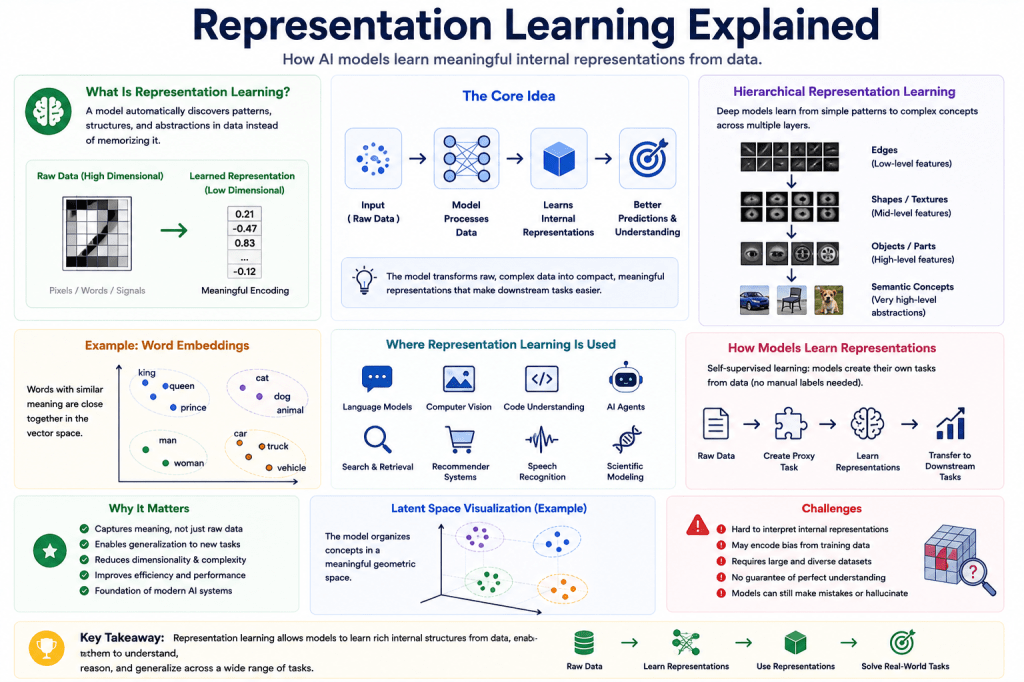
Representation learning is the process by which AI models automatically discover meaningful internal patterns, structures, and abstractions from data.
This concept sits at the heart of:
- deep learning
- transformers
- computer vision
- language models
- embeddings
- reasoning systems
- autonomous AI agents
Without representation learning, modern AI systems such as:
- large language models
- image generators
- coding agents
- recommendation systems
would not work.
Understanding representation learning is essential for understanding how modern AI systems actually “understand” information internally.
What Is a Representation?
A representation is an internal encoding of information learned by a model.
Instead of storing raw input directly, neural networks transform data into mathematical structures that capture:
- meaning
- patterns
- relationships
- features
- context
Example:
A raw image is just pixels:
[255, 128, 64, ...]
But internally, a neural network may learn representations for:
- edges
- shapes
- textures
- objects
- faces
- scenes
The network progressively transforms raw data into increasingly meaningful abstractions.
The Core Idea of Representation Learning
Traditional machine learning often required humans to manually define features.
Example:
Image classifier:- detect edges- detect corners- detect shapes
This process was called:
Feature Engineering
Modern deep learning systems instead learn these features automatically.
The model itself discovers useful internal representations from data.
This shift was revolutionary.
A Simple Mental Model
You can think of representation learning as:
“Learning how to describe the world internally.”
Instead of:
- memorizing raw data
the model learns:
- compressed structures
- semantic relationships
- abstract concepts
These learned representations become the foundation for reasoning and prediction.
Example: Learning Digits
Imagine training a neural network to recognize handwritten digits.
Initially, the network only sees:
Pixel values
Over time, the model may internally learn representations for:
- curves
- loops
- vertical lines
- digit shapes
Eventually it learns abstract concepts like:
- “This pattern resembles a 3”
- “This structure resembles an 8”
The model constructs increasingly meaningful internal representations.
Layers and Representation Hierarchies
Deep neural networks build representations layer-by-layer.
Early layers learn simple patterns.
Later layers learn abstract concepts.
Example:
Input Pixels ↓Edges ↓Shapes ↓Objects ↓Semantic Understanding
This hierarchical representation learning is one reason deep learning became so powerful.
Representation Learning in Language Models
Large language models also learn representations.
Words are not stored as dictionary entries.
Instead, they become:
Embeddings
Embeddings are vector representations that encode:
- meaning
- relationships
- context
- similarity
Example:
The words:
- king
- queen
- prince
- monarch
may occupy nearby regions inside the model’s vector space.
This allows models to reason about semantic relationships mathematically.
Embeddings Explained
An embedding is a numerical representation of information inside a high-dimensional vector space.
Example:
"cat" → [0.23, -1.8, 0.91, ...]
The numbers themselves are not human-readable.
But mathematically, similar concepts cluster together.
Example:
- cat
- dog
- animal
may appear closer together than:
- cat
- airplane
This geometric structure emerges automatically during training.
Representation Learning and Meaning
One of the most fascinating properties of representation learning is:
Meaning emerges from statistical structure.
The model is never explicitly told:
- what a cat is
- what sarcasm is
- what a coding bug is
Instead, it discovers patterns through:
- exposure to data
- optimization
- prediction tasks
Over time, useful representations emerge naturally.
Why Representation Learning Matters
Representation learning is fundamental because raw data is often:
- noisy
- high-dimensional
- unstructured
- difficult to reason about directly
Learned representations compress information into forms that are easier for models to:
- predict
- classify
- reason about
- generate from
This enables:
- generalization
- transfer learning
- semantic understanding
- reasoning capabilities
Representation Learning vs Memorization
A major misconception is that neural networks simply memorize training data.
Modern models do memorize some information —
but representation learning is much more important.
The model learns:
- structures
- relationships
- abstractions
- statistical regularities
This is why AI systems can generalize to:
- unseen sentences
- new images
- novel coding problems
- unfamiliar tasks
Representation Learning in Computer Vision
Computer vision systems rely heavily on hierarchical representations.
Example progression:
Pixels ↓Edges ↓Textures ↓Shapes ↓Objects ↓Scenes
This allows models to recognize:
- faces
- animals
- vehicles
- medical images
- environments
without manually engineered rules.
Representation Learning in Large Language Models
Large language models learn representations for:
- words
- phrases
- syntax
- concepts
- relationships
- reasoning patterns
Transformers build contextual representations dynamically.
Example:
The word:
"bank"
has different meanings in:
- river bank
- financial bank
The model learns contextual representations based on surrounding words.
This is one reason transformers became so successful.
Latent Space
The internal representation space learned by a model is often called:
Latent Space
Latent space is where:
- concepts
- features
- semantic structures
exist mathematically.
Example:
Cat images cluster togetherDog images cluster togetherVehicles cluster elsewhere
This structure emerges automatically during training.
Latent spaces are central to:
- embeddings
- generative AI
- image models
- recommendation systems
- reasoning architectures
Representation Learning and Reasoning
Modern reasoning systems depend heavily on learned representations.
Reasoning models often manipulate:
- abstract concepts
- semantic relationships
- planning structures
- internal world models
Representation learning provides the foundation for these capabilities.
Without rich representations:
- reasoning becomes shallow
- planning becomes unreliable
- generalization weakens
Representation Learning and AI Agents
Agentic AI systems rely on representations for:
- memory
- planning
- tool usage
- environment understanding
- retrieval
- reasoning
Example:
An AI research agent may internally represent:
- competitors
- products
- documents
- goals
- workflows
inside semantic vector spaces.
These representations help agents reason about tasks over time.
Self-Supervised Learning
Modern representation learning often uses:
Self-Supervised Learning
The model learns representations from raw data without explicit labels.
Example tasks:
- predict missing words
- predict next tokens
- reconstruct images
- complete sequences
This approach enabled the rise of:
- transformers
- foundation models
- large language models
because massive datasets could be used without manual labeling.
Transfer Learning
One major advantage of representation learning is:
Transferability
Representations learned on one task can help another task.
Example:
- language understanding learned during pretraining
can later help: - coding
- summarization
- reasoning
- planning
This is one reason foundation models are so versatile.
Representation Learning in Transformers
Transformers revolutionized representation learning by enabling:
- contextual embeddings
- attention mechanisms
- long-range relationships
- scalable sequence modeling
Attention layers dynamically determine:
- which information matters
- which relationships are important
This dramatically improved language understanding.
Sparse vs Dense Representations
Representations may be:
- sparse
or - dense
Sparse Representations
Only a few dimensions are active.
Example:
[0, 0, 1, 0, 0]
Dense Representations
Many dimensions contain information.
Example:
[0.12, -0.44, 0.81, ...]
Modern embeddings are typically dense vector representations.
Representation Learning and World Models
Advanced AI systems increasingly learn representations of:
- environments
- actions
- future outcomes
- causal structures
These internal simulations are often called:
World Models
World models allow agents to:
- plan ahead
- predict consequences
- simulate environments
- evaluate strategies
Representation learning is foundational to these systems.
Challenges in Representation Learning
Despite its power, representation learning still faces challenges.
Interpretability
Internal representations are difficult to understand.
Neural networks often behave like:
- black boxes
- opaque latent systems
Researchers still struggle to fully interpret learned representations.
Bias
Representations may encode:
- social bias
- harmful stereotypes
- skewed statistical patterns
This creates major safety concerns.
Hallucinations
Rich representations do not guarantee factual accuracy.
Models may still:
- invent facts
- generate false reasoning
- produce invalid outputs
Data Dependency
Representation quality depends heavily on:
- dataset quality
- scale
- diversity
- training objectives
Poor data often leads to poor representations.
The Future of Representation Learning
Representation learning remains one of the most active areas in AI research.
Future directions include:
- multimodal representations
- reasoning-aware embeddings
- world-model architectures
- memory-enhanced systems
- sparse expert representations
- agent-centric representations
These advances will likely shape the future of:
- autonomous AI agents
- reasoning systems
- robotics
- generative AI
- intelligent software systems
Related Concepts
Representation learning connects closely to:
- embeddings
- transformers
- latent space
- world models
- chain-of-thought reasoning
- self-supervised learning
- reasoning systems
- memory architectures
- AI agent planning
Together, these concepts form the cognitive infrastructure of modern AI systems.
Final Thoughts
Representation learning is one of the foundational ideas behind modern artificial intelligence.
Instead of relying on manually engineered features, neural networks automatically learn internal representations that capture:
- meaning
- structure
- context
- relationships
- abstractions
These learned representations enable:
- language understanding
- image recognition
- reasoning
- planning
- autonomous agents
- generative AI
Modern AI systems do not merely memorize information —
they learn rich internal mathematical representations of the world.
Understanding representation learning is essential for understanding how modern AI systems actually work beneath the surface.
 Programming Agentic AI