One of the most interesting developments in modern AI systems is that newer reasoning models often appear to:
“Think longer”
Instead of instantly generating responses, these systems spend more computation working through intermediate reasoning steps before producing an answer.
This behavior has become especially visible in:
- reasoning-focused language models
- coding agents
- planning systems
- mathematical solvers
- autonomous AI agents
In many cases, the model deliberately uses:
- additional inference steps
- internal reasoning traces
- planning loops
- reflection cycles
- search strategies
before generating a final response.
But what does “thinking longer” actually mean?
Are models literally thinking?
Why does more reasoning time improve performance?
And why is this becoming central to Agentic AI?
This article breaks down the core ideas behind modern reasoning models and explains why additional reasoning computation is changing how AI systems solve problems.
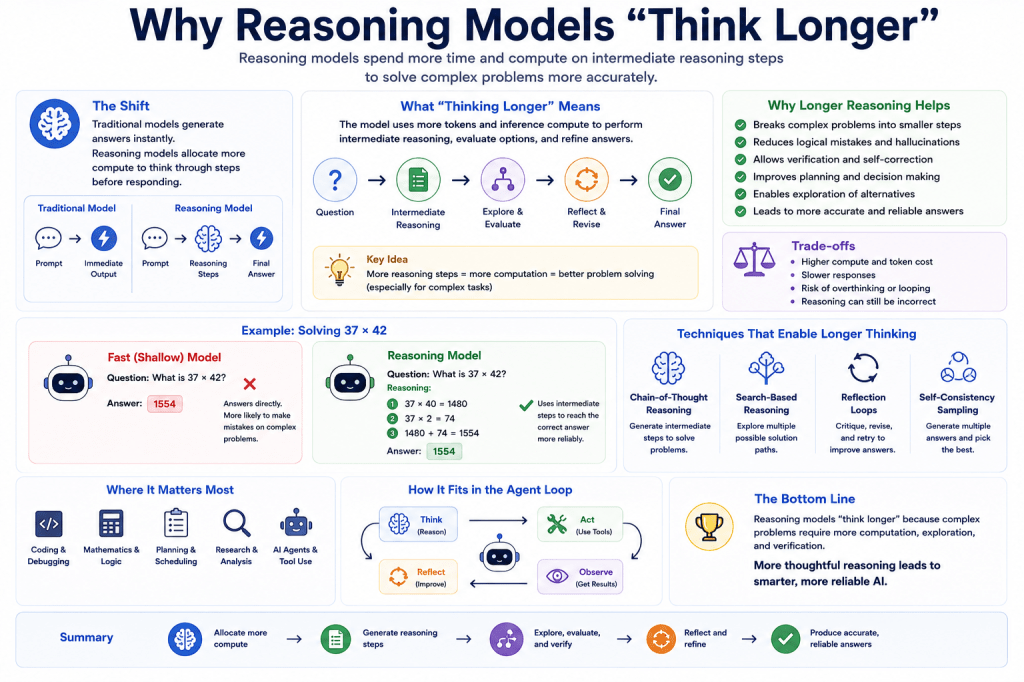
The Shift from Fast Responses to Deliberate Reasoning
Traditional language models often work like this:
Prompt → Immediate Output
The model predicts the next tokens as quickly as possible.
This works well for:
- conversational text
- summarization
- translation
- autocomplete tasks
But complex tasks are different.
Examples:
- coding
- mathematics
- planning
- scientific reasoning
- tool orchestration
- debugging
- multi-step workflows
These tasks often require:
- decomposition
- verification
- exploration
- intermediate computation
Reasoning models increasingly allocate more compute toward solving these problems.
What “Thinking Longer” Really Means
Reasoning models do not “think” like humans.
Instead, they perform additional internal computation during inference.
This may involve:
- generating intermediate reasoning steps
- evaluating alternatives
- exploring possible solutions
- revising outputs
- using search strategies
- allocating more tokens to reasoning
A simplified version looks like:
Question ↓Intermediate Reasoning ↓More Intermediate Reasoning ↓Evaluation ↓Final Answer
The model spends more computational effort before committing to a response.
Chain-of-Thought Reasoning
One major breakthrough behind this behavior is:
Chain-of-Thought Reasoning
Instead of directly answering questions, the model generates intermediate reasoning steps.
Example:
Without reasoning:
Question:What is 37 × 42?Answer:1554
With reasoning:
37 × 40 = 148037 × 2 = 741480 + 74 = 1554
The intermediate reasoning improves reliability.
This concept became foundational for modern reasoning models.
More Tokens = More Reasoning Space
One simple way to understand “thinking longer” is:
More reasoning tokens create more room for problem solving.
Instead of compressing all logic into a single generation step, the model spreads reasoning across multiple steps.
This often improves:
- accuracy
- consistency
- decomposition
- planning quality
Especially on:
- mathematics
- coding
- scientific tasks
- agent workflows
Reasoning Models Use Inference-Time Compute
Traditional AI scaling focused heavily on:
- larger models
- more parameters
- more training data
Modern reasoning systems increasingly scale using:
Inference-time compute
This means:
- spending more computation during generation
- allocating additional reasoning steps
- revisiting solutions dynamically
In other words:
Better reasoning≠ only bigger modelsBetter reasoning= smarter inference processes
This is one of the biggest conceptual shifts in modern AI research.
Why Longer Reasoning Helps
Complex tasks often require:
- sequential logic
- decomposition
- planning
- verification
A single-step prediction may fail because:
- too many dependencies exist
- intermediate calculations are needed
- logical consistency matters
Longer reasoning allows models to:
- slow down
- evaluate intermediate states
- refine conclusions
This is especially important in Agentic AI systems.
Example: Coding Tasks
Consider a coding agent fixing a software bug.
A shallow model might:
- guess a fix immediately
A reasoning model may instead:
1. Read traceback2. Inspect variables3. Analyze call stack4. Identify root cause5. Rewrite logic6. Run tests7. Verify output
The additional reasoning significantly improves reliability.
Reflection Loops
Modern reasoning systems increasingly use reflection.
Example:
Generate Answer ↓Critique Result ↓Revise Reasoning ↓Retry
This creates iterative improvement.
Reflection loops are becoming central to:
- coding agents
- research agents
- planning systems
- autonomous workflows
Search-Based Reasoning
Some advanced systems explore multiple possible reasoning paths.
Instead of:
Single reasoning chain
The model may evaluate:
Path APath BPath C
Then compare outcomes.
This family of techniques includes:
- tree-of-thought reasoning
- self-consistency sampling
- search-based planning
- branching inference
These methods dramatically increase reasoning depth.
Self-Consistency Sampling
One important reasoning technique is:
Self-Consistency Sampling
The model generates multiple reasoning attempts and compares them.
Example:
Reasoning Attempt 1Reasoning Attempt 2Reasoning Attempt 3
The system then selects the most consistent answer.
This often improves:
- mathematics
- logic tasks
- planning quality
Why Reasoning Models Matter for Agentic AI
Agentic AI systems frequently operate inside loops:
Think → Act → Observe → Repeat
The “Think” phase depends heavily on reasoning quality.
Without strong reasoning:
- plans fail
- tool usage breaks
- workflows drift
- agents hallucinate actions
Longer reasoning improves:
- planning
- decomposition
- tool orchestration
- reflection
- adaptability
This is why reasoning models are becoming foundational to autonomous AI agents.
Hidden Reasoning vs Visible Reasoning
Some systems expose reasoning steps publicly.
Others reason internally without printing intermediate thoughts.
Visible Reasoning
Step 1...Step 2...Step 3...
Useful for:
- debugging
- education
- transparency
Hidden Reasoning
The model internally allocates more inference computation before generating the final answer.
This is increasingly common in advanced systems.
World Models and Internal Simulation
Advanced reasoning systems may internally simulate:
- future actions
- environmental states
- outcomes
- plans
These internal representations are often called:
World Models
This allows agents to:
- anticipate consequences
- evaluate alternatives
- compare strategies
The longer the reasoning process, the richer these simulations may become.
Planning and Deliberation
Reasoning models increasingly resemble planning systems.
Instead of immediate responses, they:
- evaluate objectives
- sequence actions
- estimate outcomes
- revise strategies
Example:
Goal:Deploy applicationReasoning:1. Run tests2. Build container3. Validate dependencies4. Deploy service5. Check monitoring
This kind of structured reasoning is central to modern AI agents.
Why Bigger Models Alone Are Not Enough
One major realization in AI research is:
Larger models alone do not guarantee better reasoning.
A very large model may still:
- hallucinate
- skip steps
- fail logical tasks
- make arithmetic errors
Reasoning-focused architectures improve performance by enhancing:
- inference strategies
- intermediate computation
- search behavior
- planning depth
This is why reasoning systems are becoming increasingly important.
The Cost of Thinking Longer
Longer reasoning comes with tradeoffs.
Higher Compute Costs
More reasoning requires:
- more tokens
- more inference time
- more GPU usage
Reasoning-heavy systems are often more expensive.
Slower Responses
Additional reasoning delays final output generation.
Fast responses and deep reasoning often compete against each other.
Overthinking
Some systems:
- reason unnecessarily
- loop excessively
- drift away from the goal
Balancing reasoning depth is an active research challenge.
Hallucinated Reasoning
Reasoning traces may still contain incorrect logic.
The explanation can sound convincing while remaining wrong.
Reasoning improves reliability —
but does not guarantee correctness.
The Future of Reasoning Models
Modern AI is increasingly shifting toward:
- inference-time scaling
- reasoning architectures
- planning systems
- reflection loops
- search-based agents
Future systems may combine:
- reasoning
- memory
- world models
- tool orchestration
- autonomous execution
into increasingly sophisticated Agentic AI systems.
Related Concepts
Reasoning models connect closely to:
- chain-of-thought reasoning
- self-consistency sampling
- tree-of-thought reasoning
- reflection loops
- world models
- planning systems
- autonomous agents
- execution loops
- AI agent skills
Together, these systems form the cognitive foundation of modern Agentic AI.
Final Thoughts
Reasoning models “think longer” because complex problems often require more computation, more decomposition, and more intermediate reasoning before arriving at reliable answers.
Instead of generating immediate outputs, these systems increasingly:
- reason step-by-step
- explore alternatives
- revise conclusions
- reflect on outcomes
- simulate plans
This shift from:
- fast prediction
to - deliberate reasoning
is one of the biggest architectural changes in modern AI systems.
As Agentic AI continues evolving, longer reasoning processes will likely become one of the key mechanisms enabling:
- autonomous agents
- advanced planning
- reliable coding systems
- multi-step workflows
- intelligent software orchestration
The future of AI may depend not only on larger models —
but on models that reason more effectively over time.
 Programming Agentic AI