One of the most important breakthroughs in modern AI systems is the ability for models to reason through problems step-by-step instead of immediately generating answers.
This capability is commonly called:
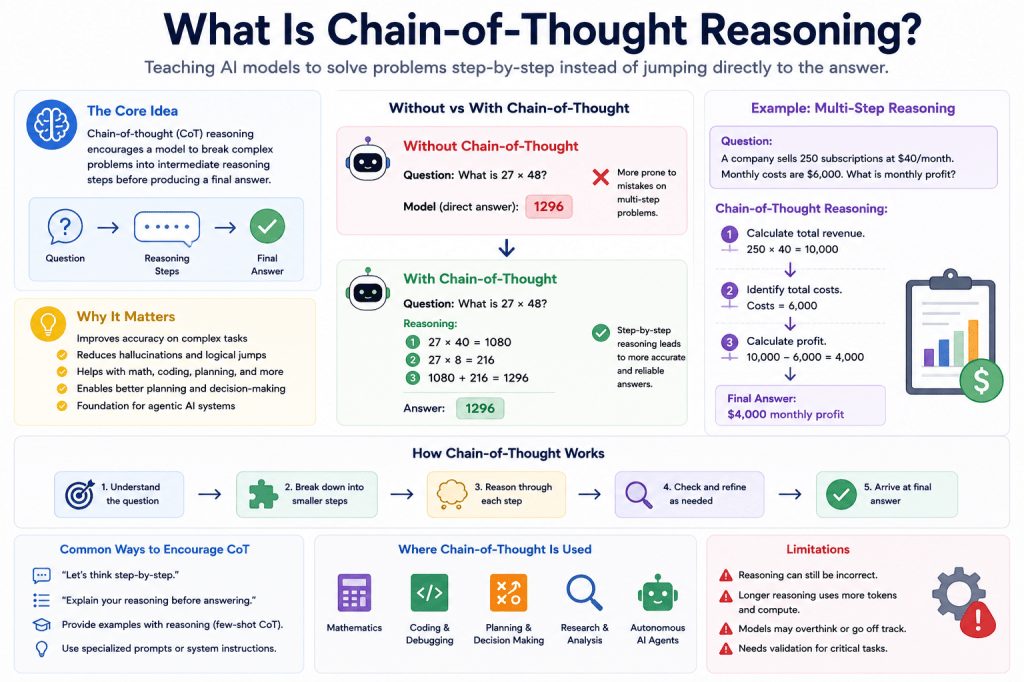
Chain-of-Thought Reasoning
Chain-of-thought reasoning (often abbreviated as CoT) allows AI systems to generate intermediate reasoning steps before arriving at a final answer.
Instead of jumping directly to a conclusion, the model works through the problem incrementally.
A simple example looks like this:
Question:If a store sells 3 laptops for $900 each, what is the total?Reasoning:3 × 900 = 2700Answer:$2700
While this example is simple, the same principle scales to:
- mathematical reasoning
- coding
- planning
- research
- tool usage
- multi-step problem solving
- autonomous AI agents
Chain-of-thought reasoning has become one of the foundational ideas behind modern Agentic AI systems.
Why Chain-of-Thought Reasoning Matters
Traditional language models often behave like pattern-completion systems.
Example:
Prompt → Immediate Output
This works well for:
- text generation
- summarization
- translation
- conversational tasks
But many real-world problems require intermediate reasoning.
Examples:
- solving equations
- debugging software
- planning workflows
- analyzing datasets
- comparing alternatives
- decomposing goals
Without intermediate reasoning, AI systems often:
- hallucinate
- skip logic
- make arithmetic mistakes
- fail at multi-step tasks
Chain-of-thought reasoning helps overcome these limitations.
The Core Idea
The key idea behind chain-of-thought reasoning is simple:
Break complex problems into smaller reasoning steps.
Instead of:
Question → Final Answer
The process becomes:
Question ↓Reasoning Step 1 ↓Reasoning Step 2 ↓Reasoning Step 3 ↓Final Answer
This dramatically improves reasoning performance.
Human Reasoning vs AI Reasoning
Humans rarely solve complex problems instantly.
Instead, people:
- analyze
- plan
- evaluate
- revise
- calculate intermediate results
Chain-of-thought reasoning attempts to simulate this behavior inside AI systems.
Example:
Without Chain-of-Thought
Question:What is 27 × 48?Model:1296
The model guesses directly.
With Chain-of-Thought
27 × 4827 × 40 = 108027 × 8 = 2161080 + 216 = 1296
The model reasons explicitly.
Chain-of-Thought Prompting
One of the earliest major discoveries was that models reason better when prompted to “think step-by-step.”
Example:
Solve this problem step-by-step.
Or:
Explain your reasoning before answering.
These prompts often significantly improve performance on:
- logic tasks
- mathematics
- planning
- coding
- multi-step analysis
This became known as:
Chain-of-Thought Prompting
Zero-Shot vs Few-Shot Chain-of-Thought
There are multiple ways to encourage reasoning.
Zero-Shot Chain-of-Thought
The model receives a reasoning instruction directly.
Example:
Let's think step-by-step.
This is surprisingly effective for many tasks.
Few-Shot Chain-of-Thought
The model is shown examples of reasoning before solving a new problem.
Example:
Example:Question → Reasoning → AnswerThen:New Question
This teaches the model the reasoning pattern.
Why Chain-of-Thought Improves Performance
Chain-of-thought reasoning improves AI performance because it:
- reduces logical jumps
- encourages decomposition
- exposes intermediate computation
- improves consistency
- allows self-correction
- supports planning
Instead of compressing everything into one generation step, the model distributes reasoning across multiple stages.
Chain-of-Thought and Agentic AI
Chain-of-thought reasoning is deeply connected to Agentic AI systems.
Modern agents frequently use reasoning loops such as:
Think → Act → Observe → Repeat
The “Think” phase often uses chain-of-thought reasoning internally.
Example:
Goal:Research AI competitors.Reasoning:1. Identify competitors2. Search pricing3. Compare features4. Build report
Without reasoning steps, autonomous agents become unreliable.
Chain-of-Thought and Planning
Planning systems rely heavily on intermediate reasoning.
Example:
Goal:
Build a travel itinerary.
Possible reasoning chain:
1. Determine destination2. Check flights3. Compare hotel prices4. Optimize travel dates5. Estimate budget
This decomposition is a form of chain-of-thought planning.
Chain-of-Thought in Coding Agents
Coding agents heavily rely on reasoning traces.
Example:
Bug detected.Reasoning:1. Inspect error message2. Locate failing function3. Analyze variable types4. Identify mismatch5. Rewrite logic6. Retest code
This stepwise reasoning significantly improves debugging performance.
Modern coding systems increasingly use:
- reasoning traces
- reflection loops
- iterative planning
- execution-feedback cycles
Chain-of-Thought and Mathematical Reasoning
Chain-of-thought reasoning became especially important for:
- arithmetic
- algebra
- symbolic reasoning
- theorem solving
Models without reasoning traces often fail on:
- multi-step calculations
- logical deductions
- compositional problems
Chain-of-thought dramatically improves these capabilities.
Example: Multi-Step Reasoning
Question:
A company sells 250 subscriptions at $40/month. Monthly costs are $6,000. What is monthly profit?
Without Chain-of-Thought
The model may guess incorrectly.
With Chain-of-Thought
Revenue:250 × 40 = 10,000Profit:10,000 − 6,000 = 4,000Answer:$4,000 monthly profit
Intermediate reasoning improves reliability.
Hidden vs Visible Reasoning
Modern reasoning systems may use:
- visible reasoning
- hidden internal reasoning
Visible Reasoning
The model prints intermediate reasoning steps.
Example:
Step 1...Step 2...Step 3...
Hidden Reasoning
The model internally allocates more computation before generating the final answer.
Many modern reasoning models use hidden reasoning traces internally.
This is increasingly important in advanced reasoning systems.
Chain-of-Thought and Reflection
Advanced agents often combine:
- chain-of-thought reasoning
- reflection loops
- critique systems
Example:
Reason ↓Generate Answer ↓Critique Result ↓Revise Reasoning ↓Retry
This iterative process improves:
- accuracy
- reliability
- robustness
Chain-of-Thought vs Memorization
One misconception is that chain-of-thought simply exposes memorized answers.
In reality, reasoning systems often:
- compose intermediate logic
- perform dynamic decomposition
- simulate planning
- execute structured problem solving
This is one reason reasoning models behave differently from simple text predictors.
Chain-of-Thought and World Models
Advanced reasoning systems increasingly build internal representations of:
- environments
- goals
- future states
- possible actions
These internal representations are sometimes called:
World Models
Chain-of-thought reasoning often operates on top of these internal representations.
This connection is central to advanced Agentic AI architectures.
Chain-of-Thought and Tree Search
Some systems extend chain-of-thought into branching reasoning structures.
Instead of a single reasoning chain:
Step A → Step B → Step C
The model explores multiple possible paths:
Path 1Path 2Path 3
This enables:
- exploration
- comparison
- self-consistency
- planning optimization
This family of methods includes:
- tree-of-thought reasoning
- self-consistency sampling
- search-based planning
Limitations of Chain-of-Thought
Despite its power, chain-of-thought reasoning still has limitations.
Hallucinated Reasoning
Models may generate plausible but incorrect reasoning chains.
The explanation may sound logical while still being wrong.
Computational Cost
Longer reasoning traces require:
- more tokens
- more inference time
- higher compute costs
Overthinking
Some models may:
- produce unnecessary reasoning
- drift away from the goal
- loop excessively
Reasoning Does Not Guarantee Correctness
Step-by-step explanations can still contain errors.
Reasoning traces improve reliability —
but they do not guarantee truth.
Chain-of-Thought in Modern AI Systems
Chain-of-thought reasoning now appears throughout modern AI systems, including:
- coding agents
- research agents
- planning systems
- autonomous workflows
- mathematical solvers
- reasoning models
- multi-agent systems
It has become one of the foundational mechanisms behind:
- reasoning
- planning
- decomposition
- execution orchestration
Related Concepts
Chain-of-thought reasoning connects closely to:
- reasoning models
- reflection loops
- self-consistency sampling
- tree-of-thought reasoning
- planning systems
- world models
- representation learning
- agent loops
- tool-using agents
These ideas collectively form the foundation of modern Agentic AI architectures.
Final Thoughts
Chain-of-thought reasoning represents one of the most important developments in modern AI systems.
By generating intermediate reasoning steps, models become significantly better at:
- problem solving
- planning
- coding
- mathematics
- decomposition
- autonomous execution
This capability is now central to:
- reasoning models
- AI agents
- autonomous workflows
- tool-using systems
As AI systems continue evolving, chain-of-thought reasoning will remain one of the key mechanisms enabling intelligent, goal-driven, agentic behavior.
 Programming Agentic AI