As AI agents become more capable, one major challenge continues to grow:
How do AI systems securely and consistently interact with external tools, applications, and data sources?
Modern AI agents often need access to:
- files
- databases
- APIs
- browsers
- cloud platforms
- development tools
- enterprise systems
But connecting every AI model to every tool individually creates enormous complexity.
This is where:
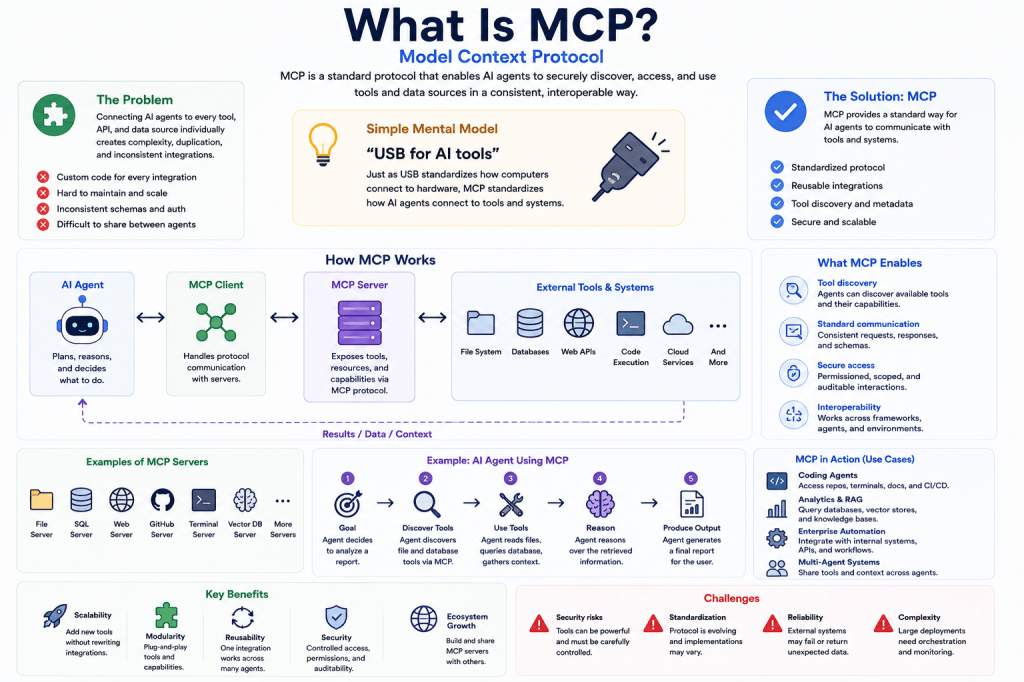
MCP
(Model Context Protocol)
enters the picture.
MCP is emerging as one of the most important architectural ideas in modern Agentic AI systems because it provides a standardized way for AI agents to communicate with tools and external environments.
In simple terms:
MCP helps AI agents use tools in a structured, interoperable, and scalable way.
Defining MCP
MCP stands for:
Model Context Protocol
It is a protocol designed to standardize how AI systems:
- discover tools
- access context
- execute actions
- retrieve information
- interact with environments
MCP acts like a communication layer between:
- AI agents
and - external systems
Instead of every AI framework inventing its own custom integrations, MCP provides a shared interface.
A Simple Mental Model
You can think of MCP as:
“USB for AI tools”
Just as USB standardized how computers connect to hardware devices, MCP aims to standardize how AI agents connect to:
- APIs
- databases
- file systems
- browsers
- software tools
- enterprise systems
This dramatically simplifies integration.
Why MCP Matters
Without a shared protocol, AI agents become difficult to scale.
Every integration requires:
- custom code
- custom schemas
- custom orchestration
- custom authentication
- framework-specific adapters
This quickly becomes chaotic.
MCP introduces:
- interoperability
- portability
- reusable integrations
- standardized communication
- scalable tool ecosystems
These are critical for production-grade Agentic AI systems.
The Core Problem MCP Solves
Imagine an AI agent that needs to:
- read files
- query databases
- browse the web
- execute Python
- manage calendars
- send emails
Without MCP, developers must individually wire:
- every tool
- every API
- every schema
- every framework integration
This creates:
- duplicated effort
- maintenance problems
- inconsistent interfaces
- fragile architectures
MCP attempts to solve this fragmentation problem.
How MCP Works
At a high level, MCP introduces standardized communication between:
AI Agent ↓MCP Client ↓MCP Server ↓External Tool or System
The AI agent does not directly manage every integration itself.
Instead:
- the MCP layer handles communication
- tools expose capabilities through MCP servers
- agents interact using standardized interfaces
MCP Servers
An MCP server exposes tools, resources, or capabilities to AI agents.
Examples include:
- filesystem servers
- database servers
- browser automation servers
- GitHub servers
- cloud platform servers
- vector database servers
An MCP server acts as a bridge between:
- the AI system
and - the external environment
Example: File System MCP Server
Imagine an agent needs to manage documents.
Without MCP:
Agent ↓Custom file integration code
With MCP:
Agent ↓MCP File Server ↓Filesystem
The agent interacts through a standardized protocol rather than bespoke integration logic.
MCP and AI Agent Skills
MCP connects directly to the concept of AI agent skills.
Examples of MCP-enabled skills include:
- file access
- database querying
- web browsing
- API interaction
- code execution
- search retrieval
MCP helps agents dynamically discover and use capabilities.
This is extremely important for scalable agent ecosystems.
MCP vs Traditional APIs
MCP does not replace APIs.
Instead, it standardizes how AI agents interact with them.
Traditional API Integration
Agent ↓Custom API wrapper ↓External Service
Each integration is manually implemented.
MCP Integration
Agent ↓MCP Protocol ↓MCP Server ↓External Service
This creates:
- consistency
- portability
- reusable orchestration
Why MCP Is Important for Agentic AI
Modern AI agents increasingly require:
- many tools
- many environments
- many integrations
Without standardization, complexity grows exponentially.
MCP enables:
- modular architectures
- reusable tool ecosystems
- scalable orchestration
- secure access patterns
- multi-agent interoperability
This is becoming foundational for large-scale agent systems.
MCP and Tool Discovery
One major advantage of MCP is tool discovery.
Agents may dynamically discover:
- available tools
- capabilities
- schemas
- actions
- resources
Example:
Available Tools:- Search Files- Execute SQL- Run Python- Browse Web
This enables far more flexible agent behavior.
MCP and Context Sharing
MCP also helps standardize context management.
Examples:
- documents
- memory
- environment state
- execution history
- shared resources
This is especially important for:
- multi-agent systems
- long-running workflows
- collaborative AI environments
MCP and Multi-Agent Systems
Advanced systems increasingly involve multiple agents working together.
Example:
Planning Agent ↓Research Agent ↓Coding Agent ↓Evaluation Agent
MCP can provide shared infrastructure for:
- communication
- context sharing
- tool orchestration
- coordination
This is one reason MCP is attracting significant attention.
Security and MCP
Security is one of the most important aspects of MCP systems.
AI agents with unrestricted tool access can become dangerous.
Examples:
- deleting files
- sending unauthorized emails
- exposing sensitive data
- executing malicious commands
MCP architectures often introduce:
- permission systems
- sandboxing
- scoped access
- approval workflows
- execution controls
Security will likely become one of the defining challenges of production agent ecosystems.
MCP and Enterprise AI
Enterprises are increasingly interested in MCP because it helps standardize AI infrastructure.
Large organizations often have:
- many internal systems
- fragmented APIs
- multiple databases
- isolated tools
MCP offers a way to unify these environments for AI agents.
Possible enterprise applications include:
- internal assistants
- workflow automation
- document retrieval
- DevOps orchestration
- cybersecurity operations
- knowledge systems
MCP and Coding Agents
Coding agents are one of the most important use cases for MCP.
Coding systems often need access to:
- repositories
- terminals
- documentation
- test environments
- CI/CD systems
MCP can standardize these interactions.
Example:
Agent ↓MCP GitHub Server ↓Repository Access
This simplifies orchestration considerably.
MCP and RAG Systems
MCP also connects naturally to:
Retrieval-Augmented Generation (RAG)
RAG systems frequently interact with:
- vector databases
- knowledge stores
- search engines
- document repositories
MCP can provide standardized retrieval interfaces for these systems.
Potential MCP Architecture
A future production system might look like:
AI Agent ↓Reasoning Layer ↓MCP Orchestrator ├── File Server ├── Database Server ├── Search Server ├── Browser Server ├── Python Execution Server └── Memory Server
MCP and Agent Frameworks
Modern frameworks increasingly explore MCP integration.
Examples include:
- PydanticAI
- LangGraph
- CrewAI
- AutoGen
- Semantic Kernel
- OpenAI Agents SDK
The ecosystem is evolving rapidly around:
- interoperability
- tool orchestration
- protocol standardization
Challenges of MCP
Despite its promise, MCP still faces challenges.
Standardization
The ecosystem is still evolving.
Different implementations may:
- vary in behavior
- differ in capabilities
- interpret schemas differently
Security Complexity
Tool-enabled agents create major security concerns.
Permission management remains difficult.
Scalability
Large MCP ecosystems may require:
- orchestration layers
- monitoring systems
- observability tooling
- governance policies
Tool Reliability
External systems may:
- fail
- timeout
- change schemas
- return invalid data
Agents must handle these failures gracefully.
The Future of MCP
MCP may become one of the foundational infrastructure layers of Agentic AI.
Possible future directions include:
- universal tool ecosystems
- standardized AI operating environments
- plug-and-play agent tools
- interoperable multi-agent systems
- enterprise AI orchestration platforms
If adoption continues growing, MCP could become a major standard for AI tool communication.
Related Concepts
MCP connects closely to:
- AI agent skills
- tool calling
- execution orchestration
- multi-agent systems
- memory architectures
- RAG pipelines
- autonomous workflows
- agent interoperability
Together, these systems form the infrastructure backbone of modern Agentic AI.
Final Thoughts
MCP represents an important step toward standardized, scalable AI agent ecosystems.
As AI systems become increasingly autonomous, they need reliable ways to:
- access tools
- retrieve information
- interact with environments
- coordinate workflows
- share context
MCP helps provide that infrastructure.
For developers building Agentic AI systems, understanding MCP is becoming increasingly important because the future of AI will likely depend not only on better models — but on better orchestration, interoperability, and tool ecosystems.
 Programming Agentic AI