Artificial intelligence systems are rapidly evolving beyond simple chat interfaces. As organizations adopt AI more deeply, two concepts are appearing everywhere:
- AI workflows
- AI agents
At first glance, these systems may seem similar. Both use large language models, automation, APIs, and orchestration. But underneath, they operate very differently.
Understanding the distinction between AI workflows and AI agents is one of the most important concepts in modern AI engineering.
This article explains:
- what AI workflows are
- what AI agents are
- how they differ
- where each approach works best
- when developers should use one over the other
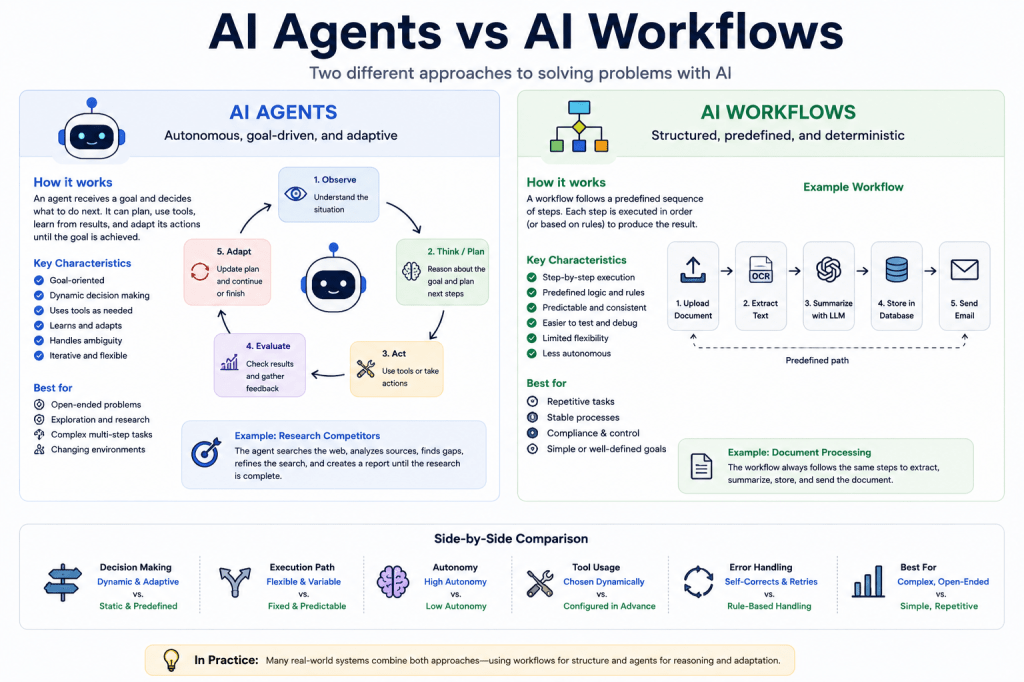
What Is an AI Workflow?
An AI workflow is a predefined sequence of steps that uses AI models as part of a larger automation pipeline.
The logic is usually:
- structured
- deterministic
- rule-based
- predictable
A workflow follows a path that developers explicitly define ahead of time.
Example:
User Uploads Document ↓Extract Text ↓Send to LLM ↓Generate Summary ↓Store in Database ↓Send Email
The system executes the same sequence every time.
Characteristics of AI Workflows
AI workflows are typically:
- structured
- repeatable
- deterministic
- task-specific
- controlled by developers
- easier to monitor
- easier to debug
The AI model is usually only one component inside the larger automation system.
Common Examples of AI Workflows
Customer Support Routing
Incoming Ticket ↓Classify Ticket Type ↓Assign Department ↓Generate Suggested Reply
Document Processing
Upload PDF ↓OCR Extraction ↓LLM Summarization ↓Store Results
Marketing Content Pipelines
Generate Blog Draft ↓SEO Optimization ↓Grammar Check ↓Publish to CMS
These systems automate tasks, but they do not independently decide what to do next.
What Is an AI Agent?
An AI agent is a system designed to pursue goals autonomously.
Instead of following a rigid predefined sequence, the agent dynamically decides:
- what actions to take
- which tools to use
- how to respond to failures
- when to continue
- when to stop
Agents operate using reasoning and execution loops.
Example:
Goal: Research competitors1. Search the web2. Analyze findings3. Detect missing information4. Search additional sources5. Build report6. Revise summary7. Export final document
The exact execution path may change every time.
The Core Difference
The simplest way to think about it is:
| AI Workflow | AI Agent |
|---|---|
| Follows predefined steps | Dynamically decides steps |
| Deterministic | Adaptive |
| Structured automation | Goal-oriented reasoning |
| Fixed execution path | Flexible execution path |
| Limited autonomy | Higher autonomy |
| Easier to predict | Harder to predict |
| Easier to debug | More complex behavior |
Workflow Thinking vs Agent Thinking
Workflow Thinking
A workflow says:
“Here are the exact steps.”
The developer defines:
- the order
- the logic
- the branching rules
- the execution path
The AI model only fills in parts of the pipeline.
Agent Thinking
An agent says:
“Here is the goal. Figure out how to achieve it.”
The system itself determines:
- task decomposition
- planning
- retries
- tool usage
- execution order
- adaptation strategies
This creates significantly more flexibility.
AI Workflows Are Usually Better for Predictable Tasks
Workflows excel when:
- the process is stable
- steps are known ahead of time
- consistency matters
- compliance matters
- debugging must remain simple
Examples:
- invoice processing
- customer ticket routing
- content publishing
- data transformation
- form handling
- CRM automation
In these cases, deterministic systems are often preferable.
AI Agents Are Better for Open-Ended Problems
Agents excel when:
- tasks are unpredictable
- environments change dynamically
- reasoning is required
- exploration is required
- planning is necessary
- tool selection varies
Examples:
- coding assistants
- research systems
- browser automation agents
- autonomous data analysis
- cybersecurity investigation systems
- multi-step planning tasks
These problems are difficult to solve using fixed pipelines.
AI Workflows Usually Use Linear Execution
Workflows are often represented as:
Step A → Step B → Step C → Step D
Or branching logic:
IF condition A: execute path 1ELSE: execute path 2
The flow structure is predetermined.
AI Agents Use Iterative Loops
Agents often operate using recursive loops:
Observe → Think → Act → Evaluate → Repeat
Or:
Goal ↓Plan ↓Execute ↓Observe Outcome ↓Revise Plan ↓Continue
Tool Usage in Workflows vs Agents
Workflows
Tool usage is predefined.
Example:
Always call:1. CRM API2. Email API3. Reporting API
The developer hardcodes the tool order.
Agents
Tool selection becomes dynamic.
The agent may decide:
- which tools are needed
- when to call them
- how many times to call them
- how to combine outputs
This creates significantly more flexibility.
Memory Differences
Workflows
Most workflows are:
- stateless
- transactional
- short-lived
They complete a task and terminate.
Agents
Agents often require:
- persistent memory
- conversation history
- long-term context
- episodic tracking
- semantic retrieval
This enables:
- continuity
- personalization
- long-running tasks
- adaptive behavior
Reliability Tradeoffs
One reason workflows remain extremely important is reliability.
AI Workflows
Advantages:
- predictable
- testable
- easier to secure
- easier to audit
- easier to scale
Disadvantages:
- rigid
- less adaptive
- harder to generalize
AI Agents
Advantages:
- adaptive
- flexible
- autonomous
- capable of handling ambiguity
Disadvantages:
- less predictable
- harder to debug
- more expensive
- more complex
- higher risk of failure loops
This tradeoff is one of the biggest design decisions in AI engineering.
Why Many “AI Agents” Are Actually Workflows
A major misconception in the AI industry is that every automated AI pipeline is an “agent.”
In reality, many so-called agents are simply:
- sequential workflows
- prompt chains
- automation pipelines
- orchestrated LLM calls
A true agent usually includes:
- dynamic planning
- autonomous decision-making
- iterative reasoning
- adaptive execution
Without those characteristics, the system is often just a workflow.
Multi-Agent Systems
Some advanced systems use multiple agents collaborating together.
Example:
Research Agent ↓Planning Agent ↓Coding Agent ↓Evaluation Agent
Each agent specializes in a particular task.
These systems introduce:
- coordination
- delegation
- negotiation
- collaborative planning
Multi-agent systems are becoming increasingly popular in enterprise AI architectures.
Each agent specializes in a particular task.
These systems introduce:
- coordination
- delegation
- negotiation
- collaborative planning
Multi-agent systems are becoming increasingly popular in enterprise AI architectures.
Real-World Example
Workflow Approach
User submits support ticket ↓Categorize issue ↓Generate response ↓Escalate if needed
Simple and predictable.
Agent Approach
Goal: Resolve customer issue1. Read ticket2. Search documentation3. Analyze account history4. Query internal systems5. Draft response6. Ask clarifying questions7. Retry failed API calls8. Escalate only if unresolved
Far more adaptive.
Popular Frameworks
Modern AI frameworks increasingly support both workflows and agents.
Examples include:
- PydanticAI
- LangGraph
- CrewAI
- AutoGen
- Semantic Kernel
- OpenAI Agents SDK
Many frameworks now support:
- graph workflows
- planning loops
- tool execution
- memory systems
- agent orchestration
When Should Developers Use Workflows?
Use workflows when:
- processes are stable
- reliability matters most
- compliance is critical
- tasks are repetitive
- execution paths are known
Workflows are often the best choice for:
- enterprise systems
- regulated industries
- predictable automation
When Should Developers Use Agents?
Use agents when:
- problems are open-ended
- environments change dynamically
- reasoning is required
- exploration matters
- flexibility is necessary
Agents work well for:
- research systems
- coding assistants
- autonomous operations
- browser automation
- dynamic planning systems
The Future: Controlled Autonomy
The future of AI engineering is unlikely to be:
- pure workflows
or - pure agents
Instead, most systems will combine:
- structured orchestration
- controlled autonomy
- reasoning systems
- deterministic guardrails
The challenge is balancing:
- flexibility
- safety
- reliability
- adaptability
This balance is becoming one of the central problems in modern AI system design.
Final Thoughts
AI workflows and AI agents solve different problems.
Workflows provide:
- predictability
- structure
- reliability
- operational control
Agents provide:
- adaptability
- autonomy
- planning
- dynamic reasoning
Understanding when to use each approach is one of the most important skills in building modern AI systems.
As Agentic AI continues evolving, developers will increasingly design hybrid systems that combine:
- workflow orchestration
- reasoning loops
- tool usage
- memory systems
- autonomous execution
The future of AI software engineering will likely belong to systems that can balance both worlds effectively.
 Programming Agentic AI