At the heart of modern Agentic AI systems is a simple but extremely powerful concept:
The Agent Loop
Most AI agents operate by repeatedly:
- thinking about a goal
- taking an action
- observing the result
- updating their understanding
- continuing until the task is complete
This iterative process allows AI systems to behave far more dynamically than traditional prompt-response chatbots.
Instead of generating a single answer and stopping, agents continuously interact with their environment, tools, memory systems, and users.
A simple representation looks like this:
Think → Act → Observe → Repeat
This loop architecture is one of the foundational building blocks of Agentic AI.
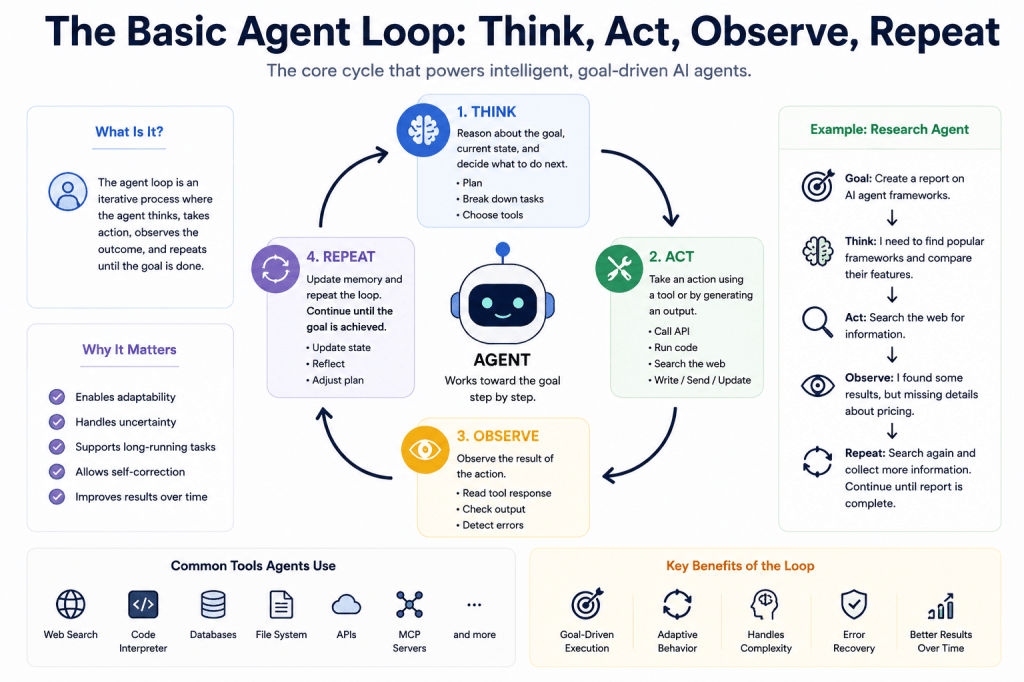
Why the Agent Loop Matters
Traditional AI systems are usually static.
Example:
User Prompt → AI Response
The interaction ends after one generation step.
Agentic systems behave differently.
They maintain ongoing execution cycles:
Goal ↓Think ↓Act ↓Observe ↓Update State ↓Continue
This transforms AI from:
- reactive systems
into: - goal-driven systems
The loop enables:
- planning
- adaptation
- retries
- self-correction
- exploration
- long-running execution
The Four Core Stages
Most agent loops contain four major phases:
- Think
- Act
- Observe
- Repeat
Let’s break down each stage.
1. Think
The thinking phase is where the agent reasons about:
- the goal
- current state
- available tools
- next actions
- possible strategies
This stage often involves:
- planning
- chain-of-thought reasoning
- decomposition
- decision-making
- reflection
Example:
Goal:
Research AI competitors.
The agent may think:
I should:1. Search for competitors2. Compare pricing3. Analyze features4. Build a summary table
The thinking stage determines what happens next.
Thinking Is Not Just Text Generation
Modern reasoning models perform internal intermediate computation.
This may include:
- task decomposition
- recursive reasoning
- branching exploration
- evaluation
- memory retrieval
- planning trees
The system effectively simulates problem solving before acting.
2. Act
Once the agent decides what to do, it executes an action.
Actions may include:
- calling APIs
- executing Python code
- querying databases
- searching the web
- using tools
- writing files
- sending messages
- interacting with software systems
Example:
Action:Search web for:"Top AI coding assistants 2026"
Or:
Action:Run Python script
The action phase connects reasoning to the external world.
Tool Usage Is Central to Modern Agents
Without tools, AI systems are mostly limited to text generation.
Tool usage dramatically expands capabilities.
Common tools include:
- web browsers
- search engines
- SQL databases
- vector databases
- APIs
- file systems
- code interpreters
- MCP servers
- cloud services
This is why modern agent frameworks heavily focus on tool orchestration.
3. Observe
After executing an action, the agent observes the outcome.
Examples:
- API response
- search results
- execution logs
- database output
- user feedback
- tool errors
- webpage content
Observation updates the agent’s understanding of the environment.
Example:
Observation:Search results incomplete.Need additional sources.
Or:
Observation:Python execution failed due to syntax error.
Observation is critical because agents must continuously adapt to new information.
Observation Creates Feedback Loops
This is where agents become dynamic systems.
The agent:
- acts
- sees what happened
- adjusts behavior
- retries if necessary
This creates iterative adaptation.
Without observation, the system cannot improve or recover from failure.
4. Repeat
The loop continues until:
- the goal is achieved
- the agent stops
- the system reaches a limit
- human intervention occurs
Example:
Think ↓Act ↓Observe ↓Need More Information? ↓YES → RepeatNO → Finish
This recursive cycle is what makes agents autonomous.
Example: Research Agent Loop
Let’s examine a realistic example.
Goal:
Create a report comparing AI agent frameworks.
Step 1 — Think
The agent reasons:
Need to:1. Find major frameworks2. Compare features3. Analyze strengths4. Generate report
Step 2 — Act
The agent:
- searches documentation
- queries APIs
- gathers data
Step 3 — Observe
The agent notices:
Missing benchmark data for one framework.
Step 4 — Repeat
The agent:
- performs another search
- gathers additional information
- revises the report
This continues until the task is complete.
Agent Loops vs Traditional Workflows
Traditional workflows are usually linear:
Step A → Step B → Step C
Agent loops are iterative:
Think → Act → Observe → Think Again
This difference is extremely important.
Workflows:
- follow predefined paths
Agents:
- dynamically adapt execution paths
Reflection Loops
Advanced agents often include reflection stages.
Example:
Think ↓Act ↓Observe ↓Critique Output ↓Improve Plan ↓Retry
This allows:
- self-correction
- iterative improvement
- higher reliability
Reflection loops are especially important in:
- coding agents
- reasoning systems
- autonomous research systems
Memory Inside the Agent Loop
Most modern agents also maintain memory during execution.
Memory may store:
- prior actions
- observations
- user preferences
- failed attempts
- retrieved documents
- long-term knowledge
This enables:
- continuity
- personalization
- context retention
- adaptive planning
Without memory, agents become fragile and repetitive.
Multi-Step Reasoning
The loop architecture enables complex reasoning over time.
Example:
Question:"Should a company migrate to LangGraph?"
The agent may:
- research LangGraph
- analyze requirements
- compare alternatives
- estimate costs
- evaluate risks
- produce recommendations
This is much more sophisticated than a single LLM response.
The ReAct Pattern
One of the most influential agent patterns is called:
ReAct
(Reason + Act)
The pattern alternates between:
- reasoning steps
- action steps
Example:
Thought:Need pricing data.Action:Search pricing pages.Observation:Found pricing table.Thought:Need competitor comparison.
ReAct-style architectures heavily influenced modern agent frameworks.
Common Agent Loop Problems
While powerful, agent loops introduce challenges.
Infinite Loops
Agents may repeatedly retry the same failing task.
Example:
Search fails ↓Retry ↓Search fails again ↓Retry forever
Systems need safeguards:
- retry limits
- timeout controls
- human intervention
Hallucinated Actions
Agents may:
- misuse tools
- invent APIs
- produce invalid commands
Observation and validation systems help reduce these issues.
Cost Explosion
Long-running loops consume:
- tokens
- compute
- API calls
Poorly designed agents can become expensive quickly.
Planning Drift
Agents sometimes lose focus on the original goal.
Example:
Goal:Research competitorsAgent:Starts summarizing unrelated AI news
Memory and goal reinforcement mechanisms help reduce drift.
Human-in-the-Loop Systems
Many production systems include human oversight.
Example:
Think ↓Generate Plan ↓Human Approval ↓Execute Action
This balances:
- autonomy
- reliability
- governance
Human review is especially important in:
- finance
- healthcare
- cybersecurity
- enterprise operations
Agent Loops in Modern Frameworks
Modern frameworks heavily revolve around execution loops.
Examples include:
- PydanticAI
- LangGraph
- CrewAI
- AutoGen
- Semantic Kernel
- OpenAI Agents SDK
These frameworks provide:
- execution orchestration
- memory management
- tool calling
- reflection loops
- multi-agent coordination
Why the Agent Loop Is Foundational
The Think → Act → Observe → Repeat cycle is foundational because it transforms AI systems into adaptive software systems.
The loop enables:
- reasoning
- planning
- execution
- learning
- adaptation
- autonomy
Without loops, modern AI agents would simply be static chatbots.
With loops, they become operational systems capable of solving real-world tasks.
Final Thoughts
The basic agent loop is one of the most important concepts in Agentic AI.
By continuously:
- thinking
- acting
- observing
- revising
AI systems can move beyond single-turn responses and begin operating autonomously across complex environments.
Almost every modern AI agent framework is built around some variation of this architecture.
Understanding the loop is essential for:
- building AI agents
- designing reasoning systems
- implementing tool usage
- orchestrating workflows
- engineering autonomous AI software
As agentic systems continue evolving, the execution loop will remain one of the core architectural patterns behind intelligent autonomous systems.
 Programming Agentic AI