As Agentic AI development grows, two frameworks are increasingly attracting attention from Python developers:
Both frameworks are designed for building:
- AI agents
- reasoning systems
- tool-calling workflows
- autonomous execution systems
- orchestration architectures
But they approach Agentic AI from very different perspectives.
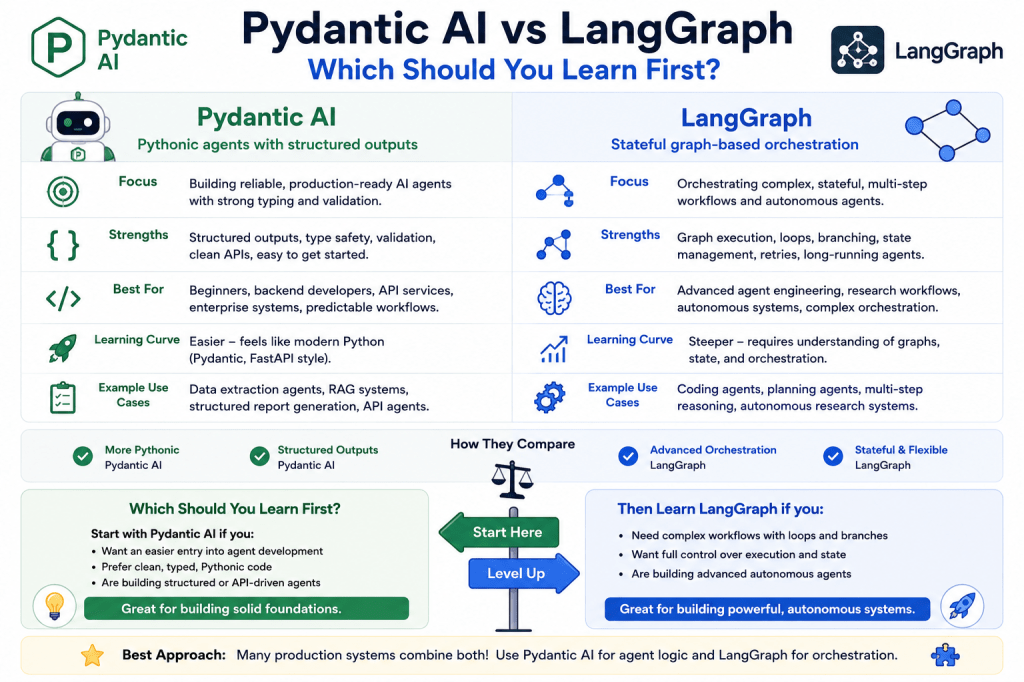
This creates a common question:
Which framework should you learn first?
The answer depends heavily on:
- your background
- your goals
- your preferred architecture style
- the types of AI systems you want to build
This article explains:
- what each framework does
- how they differ
- their strengths and weaknesses
- when to use each
- which one beginners should start with
- how they fit into modern Agentic AI engineering
Understanding this distinction is increasingly important for Python developers building modern AI systems.
The Short Answer
If you want the shortest practical recommendation:
Learn PydanticAI First If:
You want:
- cleaner Python code
- structured outputs
- simpler agent development
- production-friendly APIs
- strong typing
- easier onboarding
Especially good for:
- beginners
- backend developers
- API engineers
- structured enterprise workflows
Learn LangGraph First If:
You want:
- complex orchestration
- stateful workflows
- execution graphs
- loops and branching
- advanced agent systems
- long-running workflows
Especially good for:
- advanced agent engineering
- orchestration-heavy systems
- research workflows
- multi-step autonomous systems
What Is Pydantic AI?
PydanticAI is a Python-first AI agent framework focused heavily on:
- structured outputs
- type safety
- validation
- clean abstractions
- production reliability
The framework is heavily inspired by:
- Pydantic
- FastAPI
- modern Python engineering patterns
Its philosophy is:
“AI agents should behave like clean Python systems.”
Core Strengths of Pydantic AI
Pydantic AI emphasizes:
- readability
- maintainability
- strong typing
- predictable outputs
- clean tool integration
Example:
```python id="v3q8wr"class ResearchResult(BaseModel): topic: str summary: str```
This creates:
- structured agent outputs
- schema validation
- predictable orchestration
This is extremely valuable in:
- production systems
- enterprise AI
- APIs
- backend workflows
What Is LangGraph?
LangGraph focuses on:
Stateful Graph-Based Execution
Instead of linear workflows, LangGraph models systems as:
- nodes
- edges
- execution states
- loops
- transitions
Example:
Reason ↓Search ↓Evaluate ↓Retry
This architecture is especially useful for:
- long-running agents
- reasoning loops
- branching systems
- autonomous orchestration
Core Strengths of LangGraph
LangGraph excels at:
- execution control
- loops
- retries
- state management
- branching workflows
- graph orchestration
It is extremely powerful for:
- advanced agents
- multi-step workflows
- autonomous execution systems
The Biggest Architectural Difference
This is the single most important distinction.
Pydantic AI Focuses on:
Structured AI Behavior
It asks:
How do we make AI systems clean,typed, validated, and maintainable?
LangGraph Focuses on:
Execution Flow Orchestration
It asks:
How do we coordinate complex,stateful, looping AI workflows?
These are fundamentally different priorities.
Pydantic AI Feels More “Pythonic”
One reason developers like PydanticAI is that it feels very natural to Python developers.
The framework aligns closely with:
- dataclasses
- FastAPI
- Pydantic schemas
- typed APIs
- modern backend engineering
This lowers cognitive overhead significantly.
LangGraph Feels More Like Workflow Engineering
LangGraph feels more like:
- orchestration engineering
- distributed workflow design
- execution architecture
It introduces concepts such as:
- graph nodes
- execution edges
- state persistence
- cyclical execution
This is extremely powerful —
but more conceptually demanding.
Simplicity vs Power
Another important difference:
Pydantic AI
Prioritizes:
- simplicity
- readability
- developer ergonomics
LangGraph
Prioritizes:
- orchestration power
- execution flexibility
- advanced control
Example: Simple Research Agent
In PydanticAI, a simple research agent can often be written in relatively few lines of code.
Example:
```python id="m4r8wy"agent = Agent( "openai:gpt-4.1-mini", result_type=ResearchResult)```
This simplicity is one of the framework’s biggest strengths.
Example: LangGraph Workflow Thinking
In LangGraph, you often think in terms of:
- execution nodes
- transitions
- state graphs
Example mental model:
Planner Node ↓Tool Node ↓Evaluation Node ↓Loop Back if Needed
This is more sophisticated orchestration.
Which Framework Is Better for Beginners?
For most beginners:
Pydantic AI is probably easier to learn first.
Why?
Because it:
- feels closer to standard Python
- has cleaner abstractions
- hides orchestration complexity
- emphasizes structure
- reduces cognitive overload
Especially if you already know:
- FastAPI
- Pydantic
- backend Python
the learning curve is relatively smooth.
Which Framework Is Better for Advanced Agents?
For advanced orchestration:
LangGraph becomes extremely powerful.
Especially for:
- stateful execution
- reflection loops
- long-running agents
- autonomous workflows
- graph-based reasoning
- multi-step planning
LangGraph shines when workflows become:
- cyclical
- dynamic
- branching
- persistent
Pydantic AI Is Stronger for Structured Outputs
One of the biggest advantages of:
PydanticAI
is:
structured validation
Example:
class Result(BaseModel): answer: str confidence: float
This dramatically improves:
- reliability
- predictability
- maintainability
Especially in:
- enterprise systems
- APIs
- backend workflows
LangGraph Is Stronger for Stateful Systems
LangGraph excels when agents need:
- memory
- persistence
- retries
- loops
- branching logic
- orchestration control
This is increasingly important in:
- autonomous AI systems
- coding agents
- research agents
- multi-agent workflows
How the Two Frameworks Relate
An important insight:
They are not direct competitors.
In many real-world systems:
- they can complement each other
Example:
Pydantic AI ↓Structured Agent LogicLangGraph ↓Execution Orchestration
Future production systems may increasingly combine:
- typed AI systems
with: - graph orchestration
Pydantic AI Encourages Cleaner Engineering
One reason many developers love Pydantic AI:
It encourages:
- clean interfaces
- typed workflows
- maintainable systems
- production discipline
This is valuable because many AI codebases become:
- messy
- prompt-heavy
- difficult to debug
Pydantic AI helps reduce that chaos.
LangGraph Encourages Execution Thinking
LangGraph forces developers to think carefully about:
- execution state
- retries
- loops
- branching logic
- orchestration
This creates:
- more powerful systems
but also: - more architectural complexity
Which Framework Has the Bigger Learning Curve?
Generally:
Easier Learning Curve
PydanticAI
Steeper Learning Curve
LangGraph
Especially for developers unfamiliar with:
- state machines
- orchestration systems
- graph execution models
Recommended Learning Path
For most developers, I would recommend:
Phase 1 — Learn Pydantic AI
Focus on:
- agents
- structured outputs
- tools
- validation
- memory basics
Build:
- research agents
- API agents
- RAG systems
Then move into:
- orchestration
- loops
- stateful systems
- autonomous execution
- graph workflows
Build:
- long-running agents
- coding agents
- autonomous planners
The Enterprise Perspective
Enterprise systems increasingly care about:
- reliability
- governance
- observability
- predictability
This strongly favors:
- structured outputs
- validation
- typed systems
which is one reason:
PydanticAI
is gaining attention.
The Research Perspective
Research systems increasingly care about:
- autonomy
- execution depth
- reflection loops
- dynamic orchestration
This strongly favors:
LangGraph
especially for advanced agents.
The Future Will Likely Combine Both Ideas
The future of Agentic AI probably combines:
- structured validation
with: - advanced orchestration
Meaning:
- typed AI systems
plus: - graph-based execution systems
This is where the ecosystem appears to be heading.
Suggested Next Articles
After this article, strong follow-up topics include:
- Building Your First Agent with Pydantic AI
- LangGraph Basics Explained
- Structured Outputs in AI Agents
- Graph-Based Agent Execution
- Reflection Loops
- AI Agent Memory Systems
- Multi-Agent Coordination
- Production AI Agent Architectures
These topics collectively form the foundation of modern Agentic AI engineering.
Related Topics
This comparison connects closely to:
- Python Agent Programming
- Tool Calling
- AI Workflows
- Reflection Loops
- Memory Architectures
- MCP
- Autonomous Agents
- Graph-Based Execution
- Production AI Systems
Together, these systems form the infrastructure layer of modern Agentic AI.
Final Thoughts
PydanticAI and LangGraph represent two very important directions in modern Agentic AI engineering.
Pydantic AI focuses on:
- structured intelligence
- typed systems
- maintainable AI engineering
LangGraph focuses on:
- orchestration
- execution control
- autonomous workflow management
Neither framework is universally “better.”
Instead:
- they optimize for different architectural priorities.
For most developers:
start with Pydantic AI
Then:
expand into LangGraph
once you begin building more advanced autonomous AI systems.
 Programming Agentic AI