One of the most important architectural concepts in modern Agentic AI systems is the distinction between:
Reasoning
and
Execution
These two capabilities work together constantly inside:
- AI agents
- coding assistants
- autonomous workflows
- research systems
- orchestration frameworks
- multi-agent systems
But they are not the same thing.
Understanding the difference between reasoning and execution is essential for developers building:
- AI agents in Python
- tool-calling systems
- workflow orchestration platforms
- autonomous applications
Many AI failures happen because developers confuse:
- reasoning problems
with: - execution problems
This article explains:
- what reasoning is
- what execution is
- how they interact
- why both matter
- how modern AI systems separate them
- how advanced agents combine them effectively
This distinction sits at the heart of modern Agentic AI engineering.
The Short Version
The simplest explanation is:
Reasoning
Thinking about:
- what should happen
- what actions make sense
- how to solve a problem
- what strategy to follow
Execution
Actually:
- performing actions
- running tools
- calling APIs
- executing code
- interacting with systems
A Simple Mental Model
You can think of it like this:
Reasoning = PlanningExecution = Doing
Modern AI agents constantly alternate between these two modes.
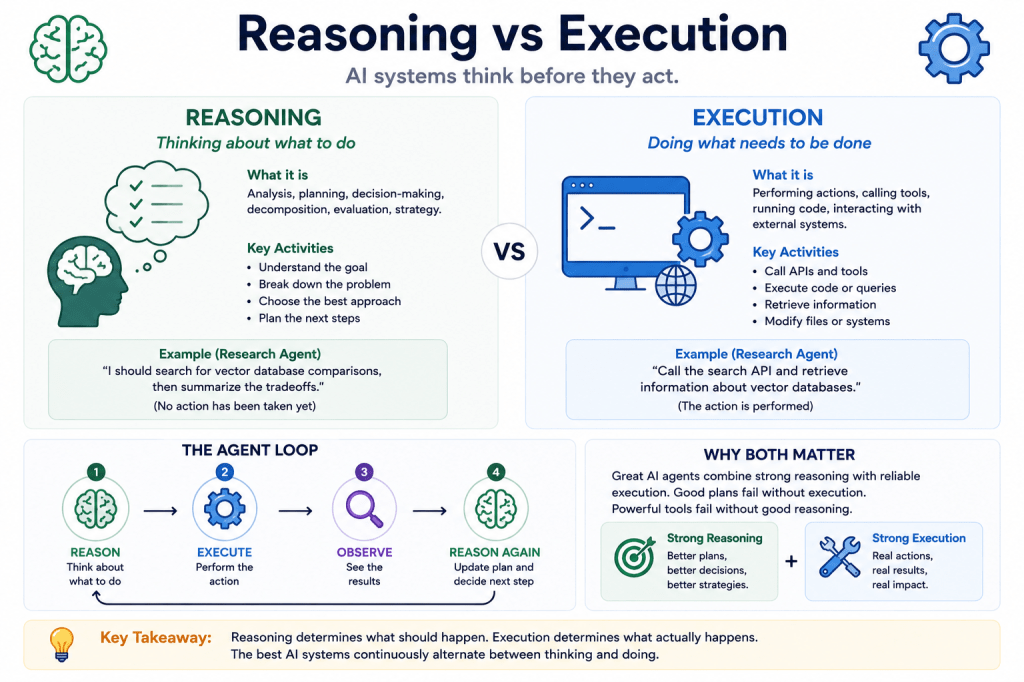
Reasoning in AI Systems
Reasoning involves:
- analysis
- planning
- decomposition
- evaluation
- decision-making
Example:
User Goal:Research vector databases
The reasoning system may decide:
1. Search documentation2. Compare products3. Summarize tradeoffs
At this stage:
- no actions have occurred yet
The system is still thinking.
Execution in AI Systems
Execution is when the system:
- performs actions
- calls tools
- runs operations
- interacts with environments
Example:
Call search APIRetrieve documentsExecute SQL queryRun Python code
This is operational behavior.
Why the Distinction Matters
Many modern AI systems fail because:
- reasoning is strong
but: - execution is weak
Or:
- execution is powerful
but: - reasoning is poor
Both systems must work together.
Example: Coding Agent
Imagine an AI coding assistant.
Reasoning Phase
The agent thinks:
1. Analyze bug2. Identify root cause3. Plan code fix
Execution Phase
Then the agent:
- edits files
- runs tests
- executes code
- validates output
Reasoning and execution continuously alternate.
The Basic Agent Loop
Modern AI agents often operate like this:
Think ↓Act ↓Observe ↓Reason Again
Or more explicitly:
Reason ↓Execute ↓Observe Results ↓Reason Again
This loop is foundational to Agentic AI.
Reasoning Without Execution
Some AI systems only reason.
Example:
- answering conceptual questions
- explaining mathematics
- generating summaries
Example:
"What is representation learning?"
The model reasons —
but performs no external actions.
This is still useful —
but not agentic execution.
Execution Without Reasoning
Traditional software often executes without reasoning.
Example:
send_email()generate_report()backup_database()
The software follows:
- predefined instructions
without:
- adaptive planning
- dynamic problem solving
Agentic AI Combines Both
Modern AI agents combine:
reasoning
with:
execution
Example:
Goal ↓Reason About Goal ↓Choose Tool ↓Execute Tool ↓Observe Result ↓Reason About Next Step
This creates:
- adaptive workflows
- autonomous systems
- intelligent orchestration
Execution Is Usually Powered by Tools
Execution often relies on:
- APIs
- Python functions
- databases
- MCP servers
- shell commands
- browsers
- external systems
Examples:
- web search
- SQL execution
- file editing
- Python interpreters
Execution interacts with the outside world.
Example: Research Agent
Reasoning
I should search for vector database comparisons.
Execution
Call web search tool
Observation
Search results returned.
Reasoning Again
Now summarize the tradeoffs.
This continuous alternation creates autonomous behavior.
Chain-of-Thought and Reasoning
Reasoning models increasingly generate:
- intermediate reasoning traces
- planning steps
- decomposition chains
Example:
1. Analyze request2. Evaluate tools3. Select strategy
This is reasoning —
not execution.
Tool Calling and Execution
Tool calling enables:
execution behavior
Example:
search_results = search_web(
    "vector databases"
)
The actual tool invocation is:
- execution
Why Execution Is Harder Than It Looks
Execution introduces many challenges:
- permissions
- APIs
- networking
- retries
- failures
- side effects
Reasoning may be correct —
but execution may still fail.
Example:
Good planBad API call
Why Reasoning Is Harder Than It Looks
Execution alone is not enough.
Without strong reasoning:
- agents misuse tools
- workflows drift
- plans fail
- loops become chaotic
Execution without reasoning often creates:
- brittle systems
Modern AI Agents Separate These Layers
Many advanced systems explicitly separate:
- reasoning
from: - execution
Example architecture:
Reasoning Engine ↓Action Planner ↓Execution Layer ↓Observation Layer
This improves:
- modularity
- reliability
- debugging
Reasoning Models “Think Longer”
Modern reasoning models increasingly spend more computation on:
- planning
- decomposition
- evaluation
- reflection
This improves:
- execution quality
because:
- better planning usually leads to better actions
Reflection Loops
Advanced agents often critique execution results.
Example:
Execute Action ↓Observe Failure ↓Reason About Failure ↓Retry Differently
This creates:
- adaptive correction
- self-improvement behavior
Multi-Agent Systems
In advanced systems:
- some agents may specialize in reasoning
while: - others specialize in execution
Example:
Planning Agent ↓Execution Agent ↓Evaluation Agent
This separation is becoming increasingly common.
Reasoning vs Execution in Coding Agents
Coding agents provide one of the clearest examples.
Reasoning Layer
The agent:
- analyzes bugs
- plans fixes
- evaluates architecture
Execution Layer
The agent:
- edits code
- runs tests
- executes commands
- validates outputs
Strong coding agents require both layers.
Frameworks and the Separation of Concerns
Modern frameworks increasingly separate:
- orchestration
- reasoning
- execution
Examples include:
- PydanticAI
- LangGraph
These frameworks help manage:
- state
- execution flow
- reasoning loops
- tool orchestration
Why Enterprises Care About Execution
Enterprise AI systems often prioritize:
- execution reliability
- governance
- auditability
- safety
Reasoning may be impressive —
but execution affects real systems.
Examples:
- databases
- APIs
- customer systems
- infrastructure
Execution mistakes can become expensive.
The Future of Agentic AI
The future of Agentic AI increasingly depends on improving both:
- reasoning
and: - execution
Future systems will likely feature:
- stronger planning
- better memory
- safer execution
- adaptive orchestration
- self-correction
- autonomous workflows
The interaction between these two layers is one of the central challenges in modern AI engineering.
Suggested Next Topics
After understanding reasoning vs execution, useful follow-up topics include:
- Tool Calling Explained
- Reflection Loops
- AI Agent Memory Systems
- Graph-Based Agent Execution
- Multi-Agent Coordination
- Reasoning Models Explained
- Autonomous Workflow Systems
- AI Agent Observability
These concepts collectively form the execution architecture of modern Agentic AI.
Related Topics
Reasoning vs execution connects closely to:
- chain-of-thought reasoning
- tool calling
- AI agents
- orchestration systems
- MCP
- reflection loops
- memory architectures
- autonomous workflows
- coding agents
Together, these concepts define the operational foundations of Agentic AI systems.
Final Thoughts
Reasoning and execution are two distinct —
but deeply connected —
layers inside modern AI systems.
Reasoning determines:
- what should happen
Execution determines:
- what actually happens
Modern Agentic AI systems become powerful when they effectively combine:
- planning
- tool usage
- observation
- adaptation
- autonomous execution
Understanding this distinction is essential for developers building:
- AI agents
- orchestration systems
- autonomous workflows
- intelligent software systems in Python
As Agentic AI evolves, the boundary between:
- reasoning systems
and: - execution systems
will become one of the most important architectural areas in modern AI engineering.
 Programming Agentic AI