Artificial intelligence is rapidly evolving from systems that simply generate text into systems that can reason, plan, use tools, remember information, and complete multi-step tasks autonomously. This new category of systems is commonly called Agentic AI.
Agentic AI represents one of the biggest shifts in modern software engineering. Instead of interacting with an AI model through a single prompt-and-response cycle, developers are now building systems that can:
- break problems into steps
- call APIs and external tools
- retrieve information from memory
- reflect on previous actions
- revise plans dynamically
- interact with software environments
- continue operating across long-running workflows
In other words, Agentic AI systems behave less like static chatbots and more like software agents capable of performing tasks.
Defining Agentic AI
Agentic AI refers to AI systems designed with some degree of:
- autonomy
- planning
- decision-making
- tool usage
- iterative execution
Unlike traditional AI applications that simply generate output from a prompt, agentic systems actively decide what to do next.
A basic large language model (LLM) might answer:
“Here is how to analyze sales data.”
An agentic AI system might instead:
- load the dataset
- inspect the columns
- write Python code
- execute the analysis
- generate charts
- summarize the findings
- ask follow-up questions
- revise the analysis if errors occur
This shift from response generation to goal-directed execution is the core idea behind Agentic AI.
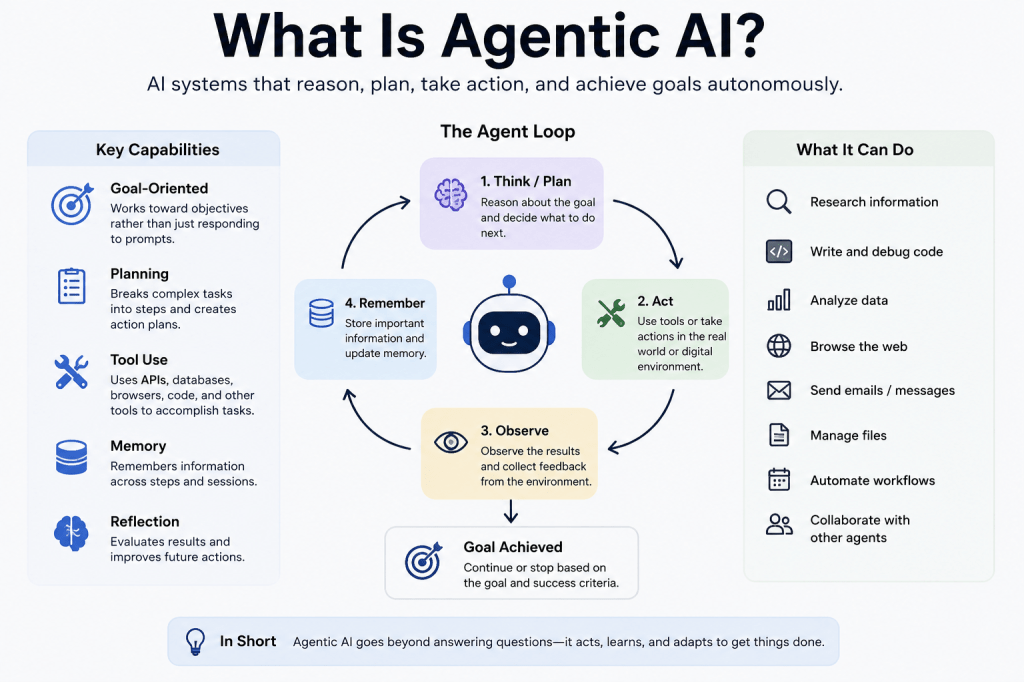
Traditional AI vs Agentic AI
Traditional AI Systems
Traditional generative AI systems are usually:
- reactive
- single-step
- stateless
- prompt-dependent
The workflow is simple:
User Prompt → Model Response
The model generates text, but it does not independently plan or execute actions.
Examples include:
- text generation
- summarization
- translation
- image captioning
- single-turn chat responses
Agentic AI Systems
Agentic systems introduce loops, memory, planning, and actions.
The workflow becomes more like:
Goal → Plan → Action → Observation → Reflection → Next Action
This means the AI system can:
- continue working over multiple iterations
- evaluate outcomes
- adapt dynamically
- recover from failures
- interact with external systems
This architecture resembles software automation more than traditional chatbot interaction.
Core Characteristics of Agentic AI
1. Goal-Oriented Behavior
Agentic systems operate toward objectives.
Instead of merely answering prompts, they attempt to achieve outcomes.
Example goals:
- “Research competing SaaS products.”
- “Build a dashboard from this CSV.”
- “Monitor prices and notify me of changes.”
- “Write and deploy a blog article.”
The system must determine the intermediate steps itself.
2. Planning
Planning is central to agentic behavior.
The AI decomposes large tasks into smaller executable actions.
Example:
Goal:
Build a travel itinerary.
Possible plan:
- Determine destination
- Research flights
- Research hotels
- Optimize travel dates
- Create schedule
- Estimate budget
Modern agent frameworks often use iterative planning loops to continuously revise execution strategies.
The Agent Loop
Many agentic systems operate using a recurring reasoning loop:
Observe → Think → Act → Evaluate → Repeat
Or more specifically:
User Goal ↓Reason About Task ↓Select Tool or Action ↓Execute Action ↓Observe Result ↓Update Memory ↓Continue or Finish
This loop architecture is one of the defining features of modern AI agents.
3. Tool Usage
Agentic AI systems often interact with external tools.
These tools may include:
- search engines
- APIs
- databases
- Python interpreters
- web browsers
- file systems
- vector databases
- enterprise software
- MCP servers
- code execution environments
Examples:
- querying SQL databases
- sending emails
- scraping websites
- generating charts
- editing files
- booking calendar appointments
Tool usage dramatically expands what AI systems can accomplish.
4. Memory
Traditional LLM interactions are often short-lived and stateless.
Agentic systems typically add memory layers.
These may include:
Short-Term Memory
Maintains current conversation/task context.
Long-Term Memory
Stores persistent information across sessions.
Episodic Memory
Tracks previous actions and outcomes.
Semantic Memory
Stores structured knowledge embeddings.
Memory allows agents to:
- avoid repeating mistakes
- maintain continuity
- personalize behavior
- improve long-running workflows
5. Reflection and Self-Correction
Some agentic systems can critique their own outputs.
This is commonly called:
- reflection
- self-evaluation
- critique loops
- iterative refinement
Example:
- Generate code
- Run tests
- Detect failures
- Revise implementation
- Retry execution
This iterative correction behavior significantly improves reliability.
Why Agentic AI Matters
Agentic AI changes how software systems are designed.
Instead of hardcoding every workflow, developers can build systems capable of dynamic reasoning.
This enables:
- adaptive automation
- autonomous workflows
- AI-powered operations
- intelligent assistants
- software agents
- autonomous research systems
- coding agents
- orchestration systems
The impact extends far beyond chatbots.
Common Types of AI Agents
Research Agents
Research information across multiple sources and synthesize findings.
Coding Agents
Generate, execute, debug, and revise software code.
Browser Agents
Interact with websites and web applications.
Data Analysis Agents
Process datasets and generate insights automatically.
Workflow Agents
Automate business processes across systems.
Multi-Agent Systems
Multiple specialized agents collaborate together.
Agentic AI vs Automation
Traditional automation follows fixed rules.
Example:
IF condition → execute predefined action
Agentic AI introduces dynamic reasoning.
The system can decide:
- what actions to take
- when to take them
- how to recover from failure
- which tools to use
- how to adapt to changing conditions
This makes agentic systems far more flexible than classical automation.
Popular Frameworks for Agentic AI
Several frameworks now help developers build AI agents.
Common examples include:
These frameworks provide components for:
- memory
- planning
- orchestration
- tool calling
- multi-agent collaboration
- observability
- evaluation
Challenges in Agentic AI
Despite rapid progress, agentic systems still face major limitations.
Reliability
Agents can hallucinate or make incorrect decisions.
Infinite Loops
Poorly designed agents may repeatedly retry tasks.
Cost
Long-running reasoning loops consume tokens and compute.
Security Risks
Tool-enabled agents may access sensitive systems.
Evaluation Difficulty
Measuring agent performance is significantly harder than evaluating single responses.
Alignment Problems
Autonomous behavior introduces governance and safety concerns.
The Rise of Production Agentic AI
Many organizations are now moving beyond experiments into production deployments.
Emerging areas include:
- AI copilots
- customer support agents
- DevOps agents
- cybersecurity agents
- finance automation agents
- enterprise workflow orchestration
- software engineering assistants
This transition is creating a new discipline:
Agent Engineering
Agent engineering combines:
- software engineering
- LLM orchestration
- systems design
- prompt engineering
- observability
- memory architecture
- workflow automation
- AI evaluation
This is rapidly becoming one of the most important domains in modern AI development.
A Simple Mental Model
A useful way to think about Agentic AI is:
| Traditional AI | Agentic AI |
|---|---|
| Generates responses | Pursues goals |
| Single interaction | Multi-step execution |
| Stateless | Memory-enabled |
| Reactive | Planning-based |
| Text-only | Tool-using |
| Passive assistant | Active software agent |
The Future of Agentic AI
The field is evolving quickly.
Current trends include:
- reasoning models
- autonomous coding systems
- multi-agent collaboration
- tool ecosystems
- MCP-based interoperability
- persistent memory architectures
- agent observability platforms
- hybrid symbolic/neural systems
- smaller specialized agent models
Over time, agentic systems may become foundational infrastructure inside modern software stacks.
Final Thoughts
Agentic AI represents a shift from AI systems that merely generate information to systems that can actively perform work.
By combining:
- reasoning
- planning
- memory
- tool usage
- reflection
- execution loops
developers can build software agents capable of handling increasingly complex real-world tasks.
For programmers, this opens a new frontier in software development:
not simply prompting models —
but engineering autonomous AI systems.
 Programming Agentic AI